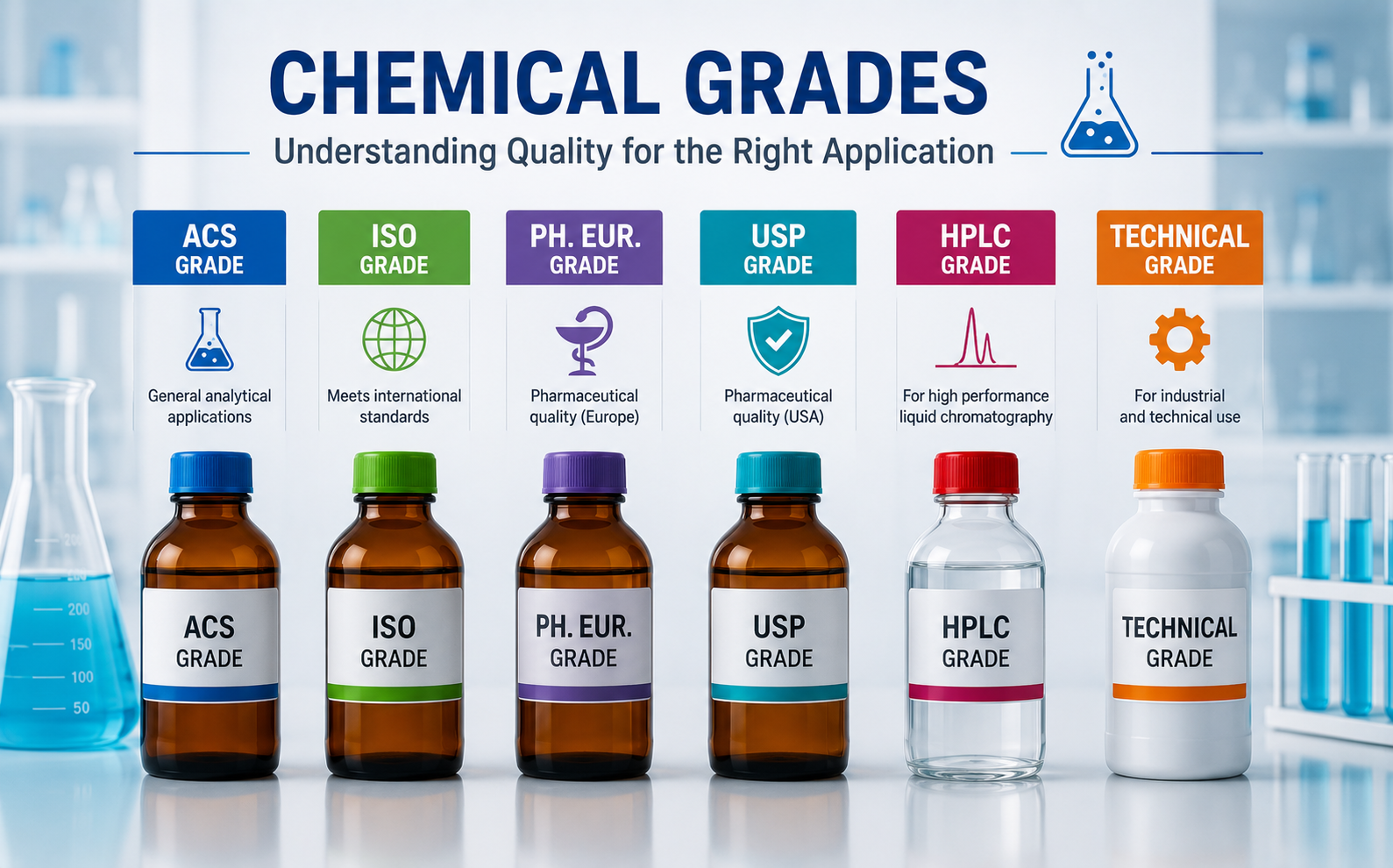
When purchasing laboratory chemicals, the same substance may be offered as ACS, ISO, Ph. Eur., USP, HPLC, Analytical Reagent, Synthesis or Technical Grade. Even products with the same chemical formula and CAS number may have different grades because chemical grade does not simply describe whether a substance is “pure” or “high quality.” A grade generally indicates that a product has been manufactured, tested or specified according to particular quality requirements, analytical applications, standards or pharmacopoeial requirements.
What Is a Chemical Grade?
A chemical grade classifies a chemical according to specified quality requirements or intended applications.
Depending on the substance and grade, specifications may include:
- Assay
- Water content
- Insoluble matter
- Residue after evaporation
- Acidity or alkalinity
- Heavy metals or specific elements
- Chloride
- Sulfate
- Iron
- UV absorbance
- Colour
- Density
- Refractive index
- Chromatographic impurities
Not every parameter applies to every chemical or grade.
Is Grade the Same as Purity?
No.
Purity or assay indicates the amount of the principal chemical component.
Grade is a broader classification describing suitability for particular applications or compliance with specified requirements.
Two solvents may both have an assay of ≥99.9%, yet only one may be suitable as HPLC Grade because additional characteristics relevant to chromatography have been controlled.
Therefore:
High purity does not automatically mean suitability for every application.
1. What Is ACS Grade?
ACS stands for the American Chemical Society.
ACS Reagent Grade chemicals are supplied to meet applicable specifications defined in ACS Reagent Chemicals.
Depending on the substance, specifications may address:
- assay,
- insoluble matter,
- selected metals,
- chloride,
- sulfate,
- iron,
- water,
- acidity or alkalinity.
Typical applications
ACS Grade reagents are widely used in:
- analytical chemistry,
- quality control,
- research laboratories,
- standard laboratory analysis,
- reagent preparation,
- R&D.
For critical applications, compliance should be confirmed using appropriate technical documentation rather than relying solely on the grade name.
2. What Is ISO Grade?
ISO refers to standards published by the International Organization for Standardization.
For laboratory reagents, an ISO designation may indicate compliance with requirements specified by an applicable ISO standard.
An important point is that there is no single universal “ISO Grade” specification covering every chemical.
The applicable ISO standard should therefore be identified.
Depending on the chemical, requirements may cover assay, chloride, sulfate, metals, insoluble matter and other impurities.
3. What Is Ph. Eur. Grade?
Ph. Eur. refers to the European Pharmacopoeia.
It provides official quality standards relevant to medicines, pharmaceutical substances and laboratory reagents used in pharmacopoeial procedures.
Depending on the applicable monograph or reagent specification, requirements may include:
- identification,
- assay,
- appearance,
- solubility,
- pH,
- related substances,
- water,
- elemental impurities,
- specific impurity tests.
Typical applications
Ph. Eur. requirements are particularly relevant to:
- pharmaceutical laboratories,
- pharmaceutical QC,
- pharmacopoeial testing,
- pharmaceutical R&D.
A Ph. Eur. reagent should not automatically be confused with a pharmaceutical ingredient complying with a Ph. Eur. substance monograph. The intended claim should always be checked.
4. What Is USP Grade?
USP stands for United States Pharmacopeia.
USP-NF standards play an important role in pharmaceutical raw materials, excipients and finished pharmaceutical products.
Depending on the applicable monograph, requirements may cover:
- identification,
- assay,
- impurities,
- water,
- residues,
- pH,
- elemental impurities.
High assay alone does not make a chemical USP compliant. Applicable monograph requirements must be considered.
5. What Is HPLC Grade?
HPLC Grade describes chemicals, particularly solvents, intended for High Performance Liquid Chromatography applications.
HPLC systems can be sensitive to trace impurities.
Depending on the solvent, relevant properties may include:
- UV absorbance,
- low non-volatile residue,
- low water content,
- particle control,
- chromatographic impurities,
- optical transmission at specified wavelengths.
Common HPLC solvents include:
- Methanol
- Acetonitrile
- Water
- Isopropanol
- Tetrahydrofuran
Why Is HPLC Grade Important?
Trace impurities in solvents can contribute to:
- baseline noise,
- unwanted peaks,
- background signals,
- reduced sensitivity,
- changes in chromatographic performance.
Therefore, general-purpose or Technical Grade solvents may not be appropriate for HPLC analysis.
6. What Is Technical Grade?
Technical Grade generally refers to chemicals intended primarily for industrial or technical applications.
These products may still have relatively high assay values, but they may not provide the same impurity controls or analytical specifications as analytical or pharmacopoeial grades.
Typical applications include:
- industrial production,
- general process applications,
- cleaning,
- certain synthesis operations,
- processes where analytical-grade purity is unnecessary.
Using Technical Grade chemicals for sensitive quantitative analysis may be inappropriate, while using unnecessarily expensive analytical grades for routine industrial processes can increase costs without providing a practical benefit.
ACS vs. ISO vs. Ph. Eur. vs. USP vs. HPLC vs. Technical Grade
| Grade | Primary Focus | Typical Application |
|---|---|---|
| ACS | ACS reagent specifications | Analytical laboratories, QC, R&D |
| ISO | Applicable ISO requirements | Standard methods, QC |
| Ph. Eur. | European Pharmacopoeia | Pharmaceutical analysis and QC |
| USP | USP-NF requirements | Pharmaceutical production and QC |
| HPLC | Chromatographic suitability | HPLC analysis |
| Technical | Industrial/technical use | Production and general processes |
The exact suitability of a product must always be evaluated against its specification and intended analytical method.
Which Grade Is the Purest?
There is no universal answer.
An ACS Grade reagent may have very strict limits for specific chemical impurities.
An HPLC Grade solvent may be optimized for UV transparency and chromatographic cleanliness.
A Ph. Eur. or USP Grade material may focus on compliance with pharmacopoeial requirements.
Therefore, grades should not be placed into a simple universal hierarchy such as:
Technical < ACS < HPLC
They represent different quality requirements for different applications.
Can ACS Grade Be Used for HPLC?
Not necessarily.
An ACS Grade solvent may have excellent chemical purity but may not have been controlled for HPLC-specific characteristics such as:
- UV absorbance,
- UV cutoff,
- particulate matter,
- non-volatile residue,
- chromatographic background.
For HPLC applications, use a solvent grade appropriate for the analytical method.
Are Ph. Eur. and USP the Same?
No.
Ph. Eur. and USP are separate pharmacopoeial systems.
For some chemicals their requirements may be similar, while for others the test methods, parameters or acceptance limits can differ.
Some products may comply simultaneously with multiple standards, such as:
ACS + ISO + Ph. Eur. + USP
but this should be confirmed through the applicable product documentation.
What Are Reagent Grade and Analytical Grade?
Other common designations include:
- Reagent Grade,
- Analytical Reagent (AR),
- Pure,
- Extra Pure,
- For Analysis,
- Reag. Ph. Eur.
Some of these terms may be manufacturer-specific classifications.
Terms such as Pure and Extra Pure should therefore not automatically be assumed to represent a universal specification.
Always review the product specification and Certificate of Analysis (CoA).
What Is Synthesis Grade?
Synthesis Grade chemicals are intended primarily for chemical synthesis.
They can provide an appropriate balance between purity and cost when the tighter analytical specifications of analytical grades are unnecessary.
What Is GC Grade?
GC Grade chemicals and solvents are intended for Gas Chromatography applications.
Control of volatile impurities is particularly important in GC.
GC Grade and HPLC Grade are therefore not necessarily interchangeable.
What Is LC-MS Grade?
LC-MS systems can be extremely sensitive to trace contamination.
Depending on the product, LC-MS Grade solvents may emphasize:
- low ionic background,
- low metal contamination,
- low particulate content,
- low residue,
- MS compatibility.
An HPLC Grade solvent should not automatically be assumed to be optimal for LC-MS.
Why Is the Certificate of Analysis Important?
A Certificate of Analysis (CoA) provides analytical information for a specific product lot.
Depending on the chemical, it may include:
- product identification,
- lot number,
- assay,
- specification limits,
- actual analytical results,
- impurity values.
For critical laboratory applications, reviewing the lot-specific CoA is an important part of chemical selection.
SDS vs. CoA
These documents have different purposes.
SDS – Safety Data Sheet: provides information about hazards, handling, storage, PPE, first aid, fire and spill response.
CoA – Certificate of Analysis: provides quality and analytical results for a product or specific lot.
In simple terms:
SDS → Safety
CoA → Quality and analytical data
How Should You Select the Correct Chemical Grade?
A practical selection process is:
Analytical Method → Chemical → Required Specification → Grade → CoA Review → Packaging & Storage
For example:
HPLC analysis → HPLC Grade solvent
Pharmacopoeial analysis → Reagent meeting the applicable Ph. Eur./USP requirements
General quantitative analysis → Appropriate ACS/ISO/AR quality
Chemical synthesis → Suitable Synthesis Grade
Industrial process → Technical Grade when appropriate
Does a Higher Grade Always Mean Better?
No.
Using HPLC Grade solvent for a simple industrial cleaning process may provide no meaningful technical benefit and significantly increase cost.
Conversely, using Technical Grade solvent for sensitive chromatography may compromise analytical results.
The objective should be to choose:
The grade that reliably meets the requirements of the application.
Common Mistakes When Selecting Chemical Grades
- Treating grade and assay as the same thing.
- Assuming the highest assay always means the best chemical.
- Using Technical Grade chemicals for sensitive analytical work.
- Assuming ACS Grade is automatically suitable for HPLC.
- Treating HPLC and LC-MS grades as identical.
- Assuming Ph. Eur. and USP requirements are always the same.
- Failing to review the CoA.
- Ignoring the analytical method's specified reagent quality.
- Selecting chemicals by name without checking the CAS number.
- Purchasing unnecessarily expensive grades for non-critical applications.
Conclusion
In laboratory chemicals, grade is not simply a ranking of chemical purity.
ACS, ISO, Ph. Eur., USP, HPLC and Technical Grade products are designed or specified around different standards, specifications and applications.
Instead of asking only:
“What is the assay?”
laboratories should ask:
“What analysis will this chemical be used for?”
“What quality does the method require?”
“Which impurities could affect the result?”
“Does the CoA demonstrate that the product meets these requirements?”
Selecting the correct chemical grade helps laboratories achieve reliable analytical results, control unnecessary costs and meet the requirements of their analytical methods.

