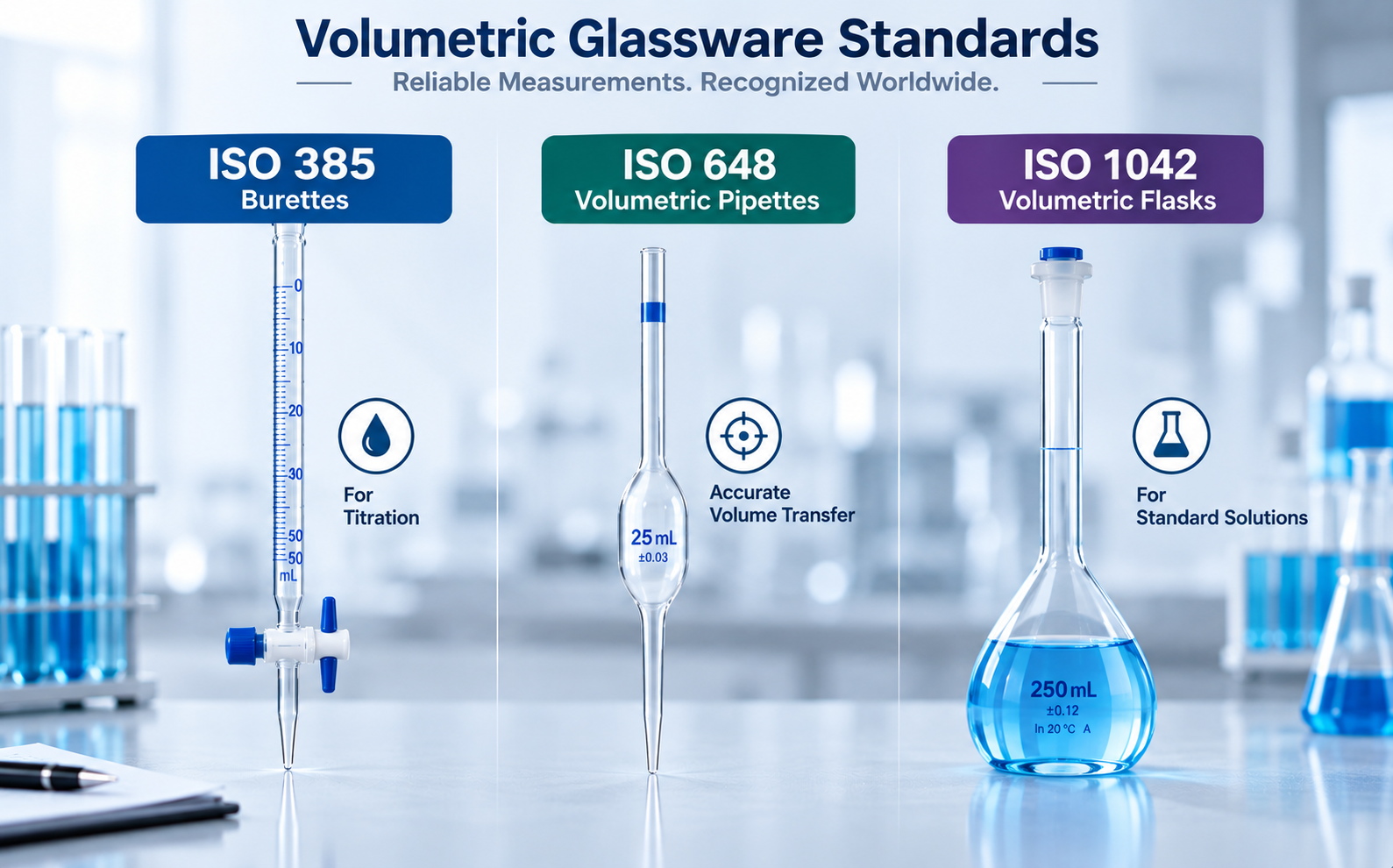
Pipettes are essential laboratory tools used for measuring, transferring and dispensing liquids. However, different pipette designs serve different purposes.
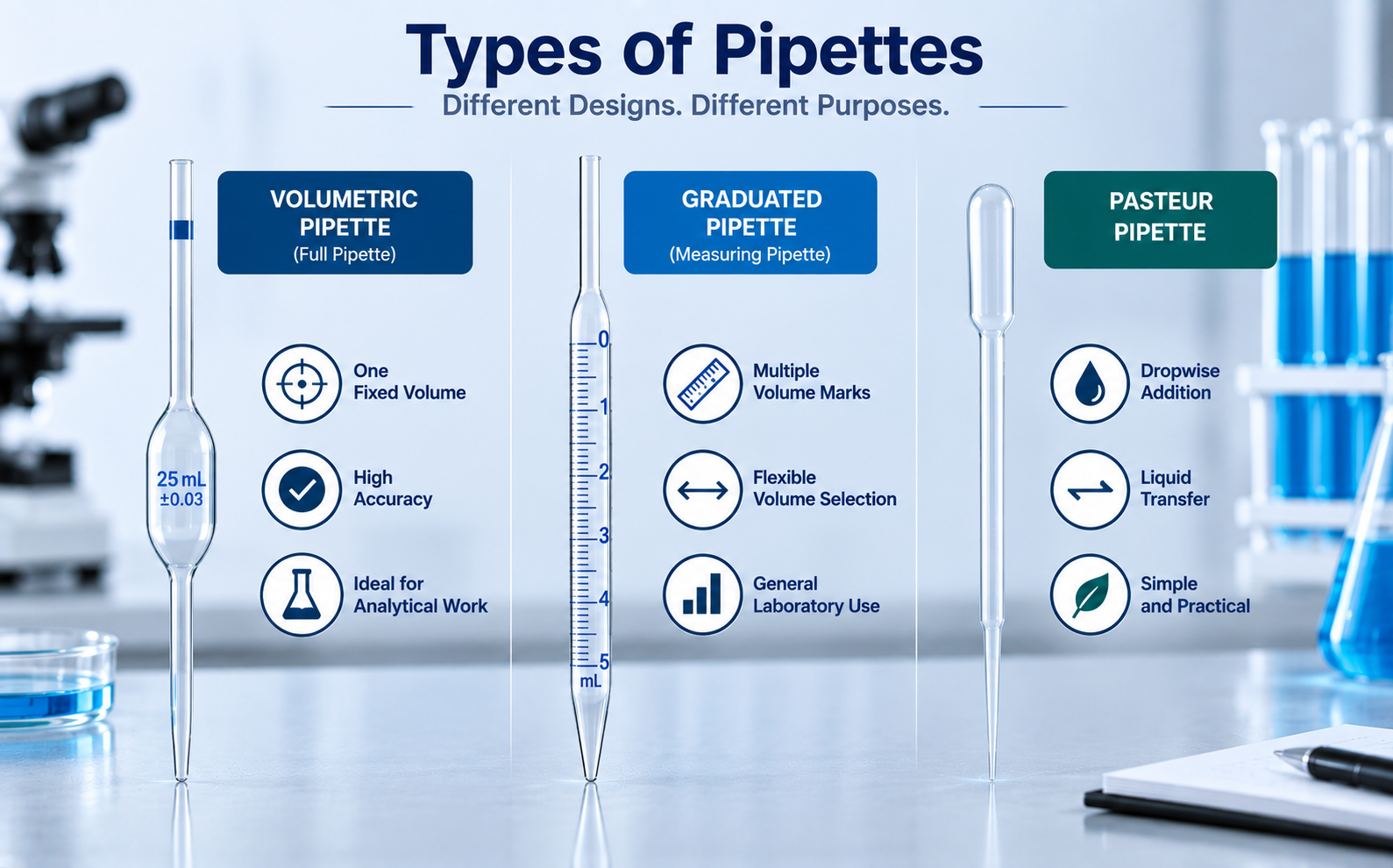
The main distinction can be summarized as:
Volumetric Pipette → Accurate transfer of one defined volume
Graduated Pipette → Measurement and transfer of different volumes
Pasteur Pipette → General liquid transfer and dropwise addition
What Is a Volumetric Pipette?
A volumetric pipette is designed to transfer one specific nominal volume with high accuracy.
Common capacities include:
- 1 mL
- 2 mL
- 5 mL
- 10 mL
- 20 mL
- 25 mL
- 50 mL
It typically has a bulb-shaped section and a single calibration mark.
Volumetric pipettes are commonly used for:
- Analytical chemistry
- Titration
- Standard solution preparation
- Accurate dilution
- Quality-control analysis
When a specific fixed volume must be transferred accurately, a suitable volumetric pipette is generally preferred.
What Is a Graduated Pipette?
A graduated pipette contains multiple graduation marks along its body.
Unlike a volumetric pipette, it can therefore be used to measure and transfer different volumes within its working range.
This provides greater flexibility, although a suitable volumetric pipette is generally preferable when maximum accuracy is required for one defined volume.
Mohr vs. Serological Pipettes
Graduated pipettes are available in different designs.
Mohr Pipette
Graduations generally stop before the tip. Delivered volume can be determined from the difference between scale readings.
Serological Pipette
Graduations may extend to the tip, and many serological pipettes are designed as blow-out pipettes.
These designs should not automatically be used in the same way. Always check the markings and manufacturer's instructions.
What Is a Pasteur Pipette?
A Pasteur pipette is a simple transfer device used to move small quantities of liquid or add liquid drop by drop.
It may be manufactured from glass or plastic.
Typical applications include:
- Dropwise addition
- Sample transfer
- Reagent addition
- Handling small quantities of liquid
- General laboratory transfer
Pasteur pipettes are generally not designed for accurate volumetric measurement.
Main Differences
| Feature | Volumetric Pipette | Graduated Pipette | Pasteur Pipette |
|---|---|---|---|
| Primary purpose | Accurate fixed-volume transfer | Measured transfer of different volumes | General liquid transfer |
| Graduations | Usually one mark | Multiple marks | Usually none |
| Volume accuracy | High | Moderate / class-dependent | Not intended for precise measurement |
| Volume flexibility | One nominal volume | Multiple volumes | Dropwise transfer |
| Analytical work | Excellent | Application-dependent | Generally unsuitable |
| Dropwise addition | Not intended | Limited | Excellent |
How Should the Meniscus Be Read?
For water and many aqueous solutions, the bottom of the concave meniscus is generally aligned with the relevant calibration mark.
The observer's eye should be at the same level as the meniscus to avoid parallax error.
Should the Last Drop Be Blown Out?
It depends on the pipette design.
Some pipettes are calibrated to deliver the correct volume after free drainage and the remaining liquid in the tip should not be blown out.
Other pipettes are specifically designed as blow-out types.
Therefore:
Do not automatically blow out every pipette.
Always follow the pipette markings, applicable standard and manufacturer's instructions.
Never Pipette by Mouth
Laboratory pipettes should never be operated by mouth.
Use an appropriate:
- Pipette filler
- Pipette pump
- Pipette controller
instead.
Class A vs. Class B Pipettes
Volumetric glass pipettes may be available as Class A or Class B.
In general:
Class A → Tighter tolerance / higher accuracy
Class B → Wider tolerance / routine applications
Exact tolerances depend on the pipette type, nominal volume and applicable standard.
Quick Selection Guide
| Requirement | Typical Choice |
|---|---|
| Accurate transfer of 25 mL | Volumetric pipette |
| Measuring different volumes | Graduated pipette |
| Standard solution preparation | Volumetric pipette |
| Routine measured transfer | Graduated pipette |
| Adding a few drops | Pasteur pipette |
| Small sample transfer | Pasteur pipette |
| High-accuracy analytical work | Suitable Class A volumetric pipette |
Conclusion
Although volumetric, graduated and Pasteur pipettes may appear similar, they are designed for different laboratory tasks.
Volumetric Pipette = Accuracy
For accurate transfer of one defined volume.
Graduated Pipette = Flexibility
For measured transfer of different volumes.
Pasteur Pipette = Transfer
For simple liquid transfer and dropwise addition.
The correct pipette should therefore be selected according to the required volume, accuracy, liquid properties and calibration design.