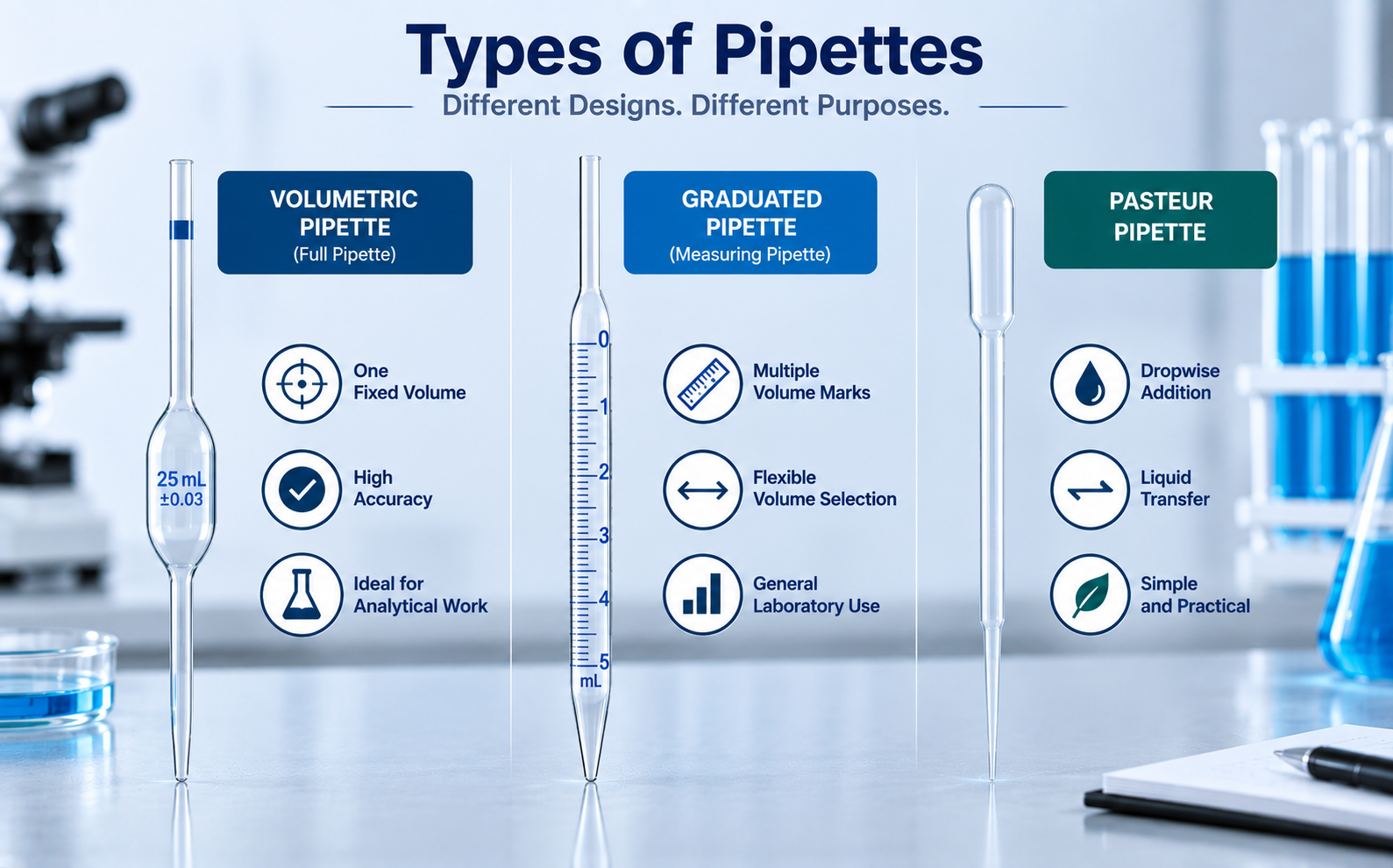
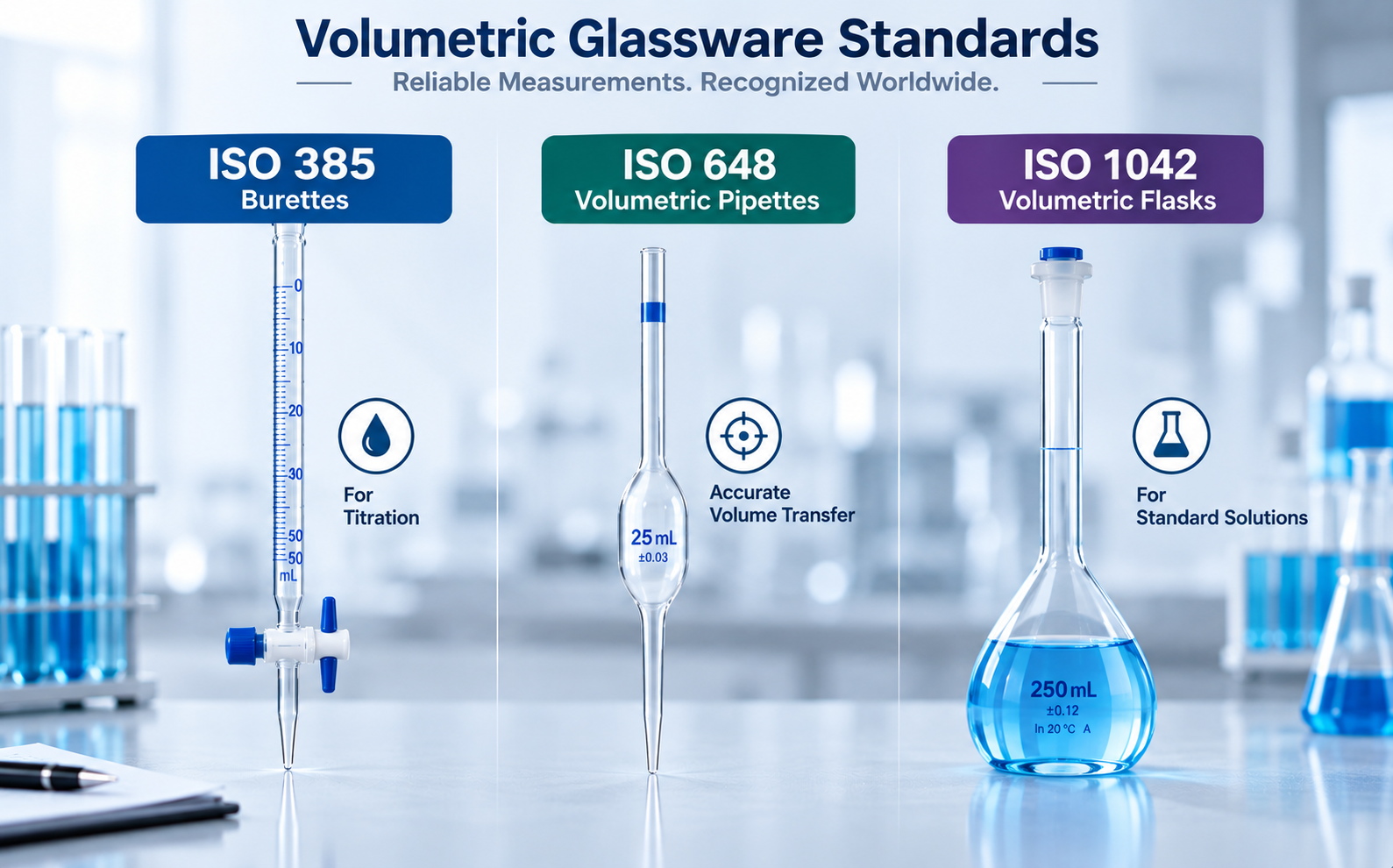
Volumetric laboratory glassware such as burettes, pipettes and volumetric flasks should not be evaluated only by their nominal capacity. Accuracy, tolerance, calibration and design requirements are also important for reliable volume measurement. Three important international standards commonly associated with volumetric laboratory glassware are: ISO 385 → Burettes ISO 648 → Single-volume pipettes ISO 1042 → One-mark volumetric flasks
What Is ISO 385?
ISO 385 covers burettes intended for laboratory use.
Burettes are primarily used for titration and controlled delivery of accurately measured liquid volumes.
The standard addresses characteristics such as:
- Nominal capacity
- Graduations
- Maximum permissible errors
- Design
- Marking
- Testing and use requirements
ISO 385 → Burettes
When selecting a burette, its capacity should therefore be considered together with its accuracy class and conformity with the relevant standard.
What Is ISO 648?
ISO 648 applies to single-volume pipettes, commonly known as volumetric pipettes.
These pipettes are designed to deliver one defined nominal volume accurately.
The standard covers requirements related to:
- Nominal capacity
- Volume tolerance
- Calibration
- Delivery characteristics
- Design
- Marking
ISO 648 → Single-Volume Pipettes
A 10 mL or 25 mL volumetric pipette should therefore be evaluated according to its specified accuracy and tolerance, not simply its nominal volume.
What Is ISO 1042?
ISO 1042 covers one-mark volumetric flasks used in laboratories.
A volumetric flask is designed to prepare a solution to one accurately defined final volume.
The standard addresses characteristics including:
- Nominal capacity
- Tolerance
- Calibration mark
- Neck and body design
- Marking
- Stopper or closure characteristics
ISO 1042 → One-Mark Volumetric Flasks
These requirements are particularly relevant when preparing standard solutions and analytical dilutions.
Quick Comparison
| Standard | Laboratory Glassware | Main Purpose |
|---|---|---|
| ISO 385 | Burette | Titration and controlled delivery |
| ISO 648 | Volumetric pipette | Accurate transfer of a defined volume |
| ISO 1042 | Volumetric flask | Preparation of a defined final volume |
An easy way to remember them:
ISO 385 = Burette
ISO 648 = Volumetric Pipette
ISO 1042 = Volumetric Flask
What Do Class A, AS and B Mean?
Volumetric glassware may be manufactured in different accuracy classes.
In general, Class A has tighter volume tolerances than Class B and is therefore preferred for more demanding analytical applications.
For some volumetric products, particularly burettes and pipettes, the designation Class AS may also be encountered. The “S” relates to specified fast-delivery/waiting-time conditions.
The exact requirements should always be checked against the applicable standard for the particular product.
Why Is 20 °C Marked on Volumetric Glassware?
Volumetric glassware is commonly calibrated at a reference temperature such as:
20 °C
Temperature is important because changes in temperature can affect both the glassware and the volume of the liquid.
For high-accuracy volumetric work, calibration temperature should therefore be considered.
What Do “In” and “Ex” Mean?
Volumetric glassware can be calibrated in different ways:
IN / TC (To Contain): Calibrated to contain the stated volume.
EX / TD (To Deliver): Calibrated to deliver the stated volume.
Volumetric flasks are generally used as IN/TC instruments, while volumetric pipettes and burettes are generally EX/TD instruments.
Understanding this distinction is important for correct volumetric technique.
Why Are ISO Standards Important?
Using volumetric glassware manufactured to defined standards helps provide:
- Defined volume tolerances
- Better comparability between products
- More reliable analytical measurements
- Standardized quality-control procedures
- More appropriate product selection
An “ISO” marking alone, however, should not be the only criterion. The specific standard, accuracy class, nominal capacity, tolerance and calibration information should be considered together.
Conclusion
ISO 385, ISO 648 and ISO 1042 are key standards associated with common volumetric laboratory glassware:
ISO 385 → Burettes
ISO 648 → Volumetric Pipettes
ISO 1042 → Volumetric Flasks
When selecting volumetric glassware, consider not only the nominal volume but also the applicable standard, accuracy class, tolerance and calibration temperature.
These factors are particularly important for titration, standard-solution preparation and analytical dilution, where accurate volume measurement directly influences the reliability of laboratory results.