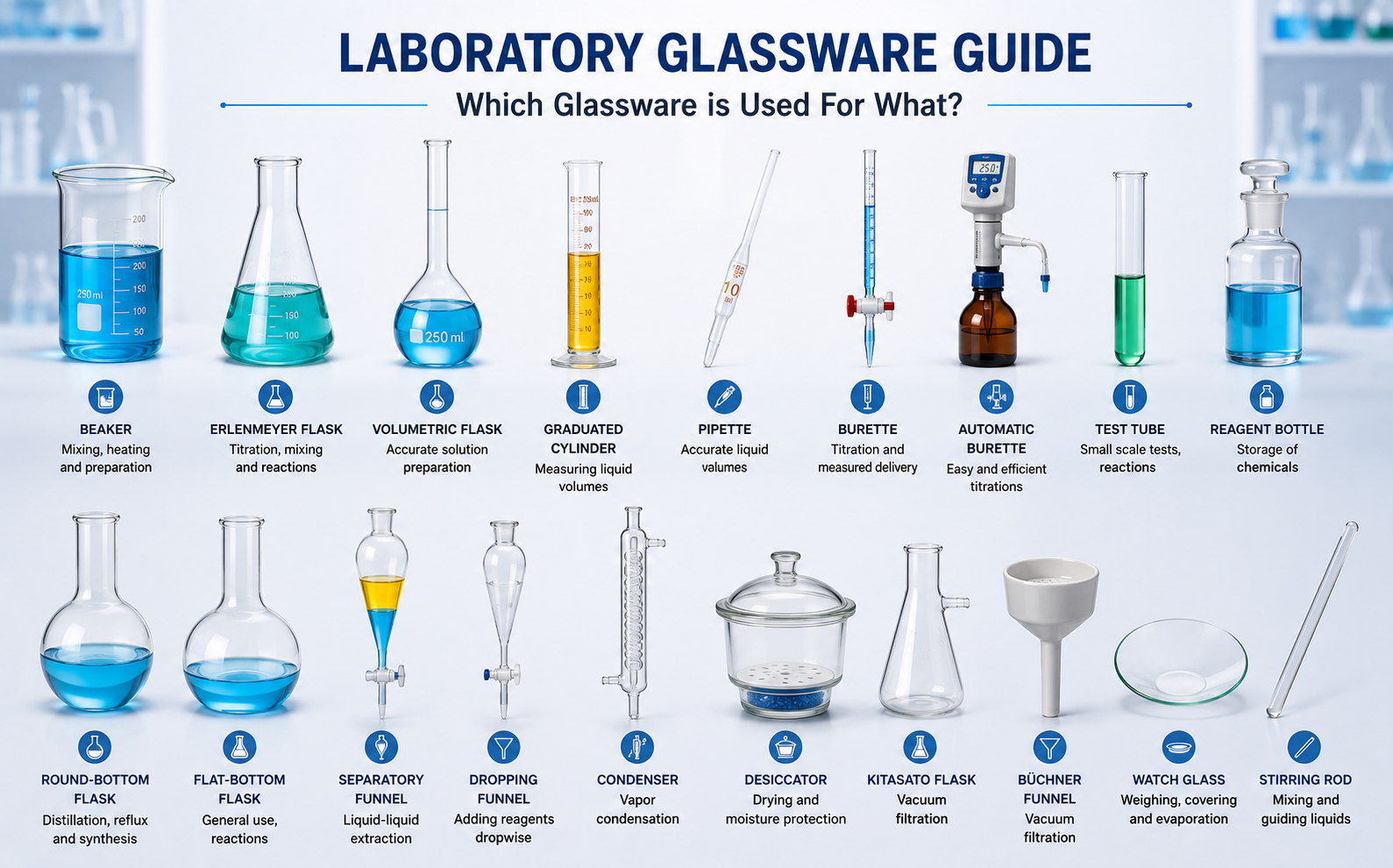
Laboratory glassware forms the foundation of many laboratory procedures, from solution preparation and titration to distillation, extraction and filtration. Although beakers, Erlenmeyer flasks, volumetric flasks, graduated cylinders, pipettes and burettes may sometimes appear interchangeable, they are designed for very different purposes. Some laboratory glassware is intended for mixing and heating, some for accurate volume measurement, while others are specifically designed for distillation, extraction, filtration or chemical storage. Understanding these differences is essential for both analytical reliability and safe laboratory work.
1. Beaker
A beaker is one of the most common pieces of laboratory glassware.
Its cylindrical body, flat base and pouring spout make it useful for:
- preparing solutions,
- mixing liquids,
- dissolving chemicals,
- sample preparation,
- controlled heating where appropriate,
- temporary liquid handling.
Graduation marks on beakers are generally intended for approximate volume estimation.
A beaker should not be used when accurate volumetric measurement is required.
2. Erlenmeyer Flask
The conical shape and narrow neck of an Erlenmeyer flask make it particularly suitable for swirling liquids with reduced splashing.
Common applications include:
- titration,
- solution preparation,
- mixing,
- sample preparation,
- chemical reactions,
- controlled heating in suitable models.
It is especially useful as the receiving vessel during manual titration.
3. Volumetric Flask
A volumetric flask is designed to prepare solutions accurately to a specified volume.
Common capacities include:
50 mL, 100 mL, 250 mL, 500 mL and 1000 mL.
Applications include:
- standard solution preparation,
- analytical dilutions,
- quantitative analysis,
- preparation of solutions with defined concentrations.
Volumetric flasks are not designed for direct heating.
4. Graduated Cylinder
Graduated cylinders are used to measure and transfer liquid volumes.
Their tall, narrow geometry generally provides better volume estimation than a beaker.
However, they typically do not provide the same accuracy as volumetric flasks or volumetric pipettes.
5. Pipettes
Pipettes are used to measure and transfer defined liquid volumes.
Volumetric Pipette
Designed to deliver one specific volume with high accuracy.
Graduated Pipette
Contains graduations allowing different volumes to be delivered.
The required accuracy and applicable standard should be considered when selecting a pipette.
6. Burette
A burette is a long graduated tube designed to deliver controlled and measurable volumes of liquid.
It is primarily used for:
- acid-base titration,
- redox titration,
- complexometric titration,
- volumetric analysis.
Important selection criteria include capacity, tolerance, accuracy class, graduation and stopcock design.
7. Automatic Burette
Automatic burettes combine a burette tube with a reagent reservoir.
They facilitate repeated filling and can be particularly useful in laboratories performing large numbers of routine titrations.
8. Test Tube
Test tubes are designed for working with relatively small quantities of samples.
Applications include:
- small-scale reactions,
- sample preparation,
- mixing,
- observational tests,
- heating where appropriate,
- microbiological procedures.
9. Reagent Bottle
Reagent bottles are used to store chemicals, reagents and prepared solutions.
Clear Glass
Useful for light-stable materials and applications where visual inspection is important.
Amber Glass
Helps reduce exposure to certain wavelengths of light and is commonly selected for photosensitive substances.
Amber glass is not completely light-proof, so storage instructions for the chemical should always be followed.
10. Dropping Bottle
Dropping bottles are useful when small quantities of reagents must be dispensed.
They are commonly used for:
- indicators,
- dyes,
- test reagents,
- small-volume solutions.
11. Round-Bottom Flask
Round-bottom flasks provide a geometry that supports more uniform heat distribution.
Typical applications include:
- organic synthesis,
- distillation,
- reflux,
- solvent evaporation,
- heated reactions.
Single-neck and multi-neck designs are available.
12. Flat-Bottom Flask
A flat-bottom flask can stand independently on a laboratory bench.
It can be useful for general solution handling and certain reactions.
For intensive controlled heating, reflux and traditional distillation systems, a round-bottom flask is often more appropriate.
13. Separatory Funnel
A separatory funnel is used to separate immiscible liquid phases.
Typical applications include:
- liquid-liquid extraction,
- phase separation,
- sample preparation,
- organic chemistry.
The position of the phases depends on their densities. The organic phase should not automatically be assumed to be the upper layer.
14. Dropping Funnel
A dropping funnel is designed to add a reagent to a reaction mixture at a controlled rate.
It is particularly useful in synthetic chemistry where reaction rate or temperature must be controlled.
Separatory funnel → Separates liquid phases
Dropping funnel → Adds reagent in a controlled manner
15. Condenser
Laboratory condensers cool vapour and convert it back into liquid.
Common designs include:
Liebig condenser: widely used for general distillation.
Allihn condenser: provides increased condensation surface and is particularly useful for reflux.
Graham condenser: uses a coiled design to provide a large heat-transfer surface.
16. Desiccator
A desiccator provides a low-humidity environment for samples.
Applications include:
- gravimetric analysis,
- cooling dried samples,
- protecting hygroscopic materials,
- moisture-sensitive sample storage.
Vacuum desiccators are specially designed products. Standard desiccators should not be subjected to vacuum unless specifically approved for that purpose.
17. Büchner Funnel
A Büchner funnel is used for vacuum filtration, normally together with a filtering flask.
Depending on the design, Büchner funnels can be manufactured from glass, porcelain or other suitable materials.
18. Glass Funnel
Conventional glass funnels are commonly used for:
- liquid transfer,
- gravity filtration,
- filtration with filter paper.
19. Glass Petri Dish
Glass Petri dishes may be used in:
- microbiological applications,
- sample handling,
- drying,
- observational procedures.
Sterilization and reuse conditions should follow the manufacturer's instructions.
20. Watch Glass
A watch glass is useful for:
- holding small samples,
- weighing solids,
- evaporating small quantities of liquid,
- loosely covering beakers,
- observing samples.
21. Crystallizing Dish
Crystallizing dishes are relatively shallow vessels with a large surface area.
They can be used for:
- crystallization,
- evaporation,
- sample preparation.
22. Glass Stirring Rod
Glass rods are used for manual stirring and controlled liquid transfer.
When pouring from a beaker, directing the liquid along a glass rod can help provide a more controlled flow.
Quick Laboratory Glassware Comparison
| Glassware | Primary Use |
|---|---|
| Beaker | Mixing and solution preparation |
| Erlenmeyer Flask | Titration and swirling |
| Volumetric Flask | Accurate solution preparation |
| Graduated Cylinder | General volume measurement |
| Pipette | Accurate liquid transfer |
| Burette | Titration |
| Test Tube | Small-scale procedures |
| Reagent Bottle | Chemical storage |
| Round-Bottom Flask | Distillation, reflux and synthesis |
| Separatory Funnel | Liquid-liquid extraction |
| Dropping Funnel | Controlled reagent addition |
| Condenser | Vapour condensation |
| Desiccator | Moisture protection |
| Glass Funnel | Transfer and filtration |
| Watch Glass | Weighing and evaporation |
| Crystallizing Dish | Crystallization and evaporation |
| Glass Stirring Rod | Mixing and transfer |
Which Glassware Should Be Used for Accurate Volume Measurement?
For approximate volume measurements, beakers, Erlenmeyer flasks and graduated cylinders may be useful depending on the required accuracy.
For more accurate volumetric work, dedicated volumetric glassware should be used, such as:
- volumetric flasks,
- volumetric pipettes,
- burettes.
Correct equipment selection is particularly important in quantitative analysis.
What Are Class A, Class AS and Class B?
Volumetric glassware may be manufactured according to different accuracy classes.
In general, Class A is associated with tighter tolerances than Class B.
Class AS is used for certain volumetric products where Class A tolerances are combined with specified shorter delivery/waiting characteristics.
The exact meaning should always be interpreted according to the product type and applicable standard.
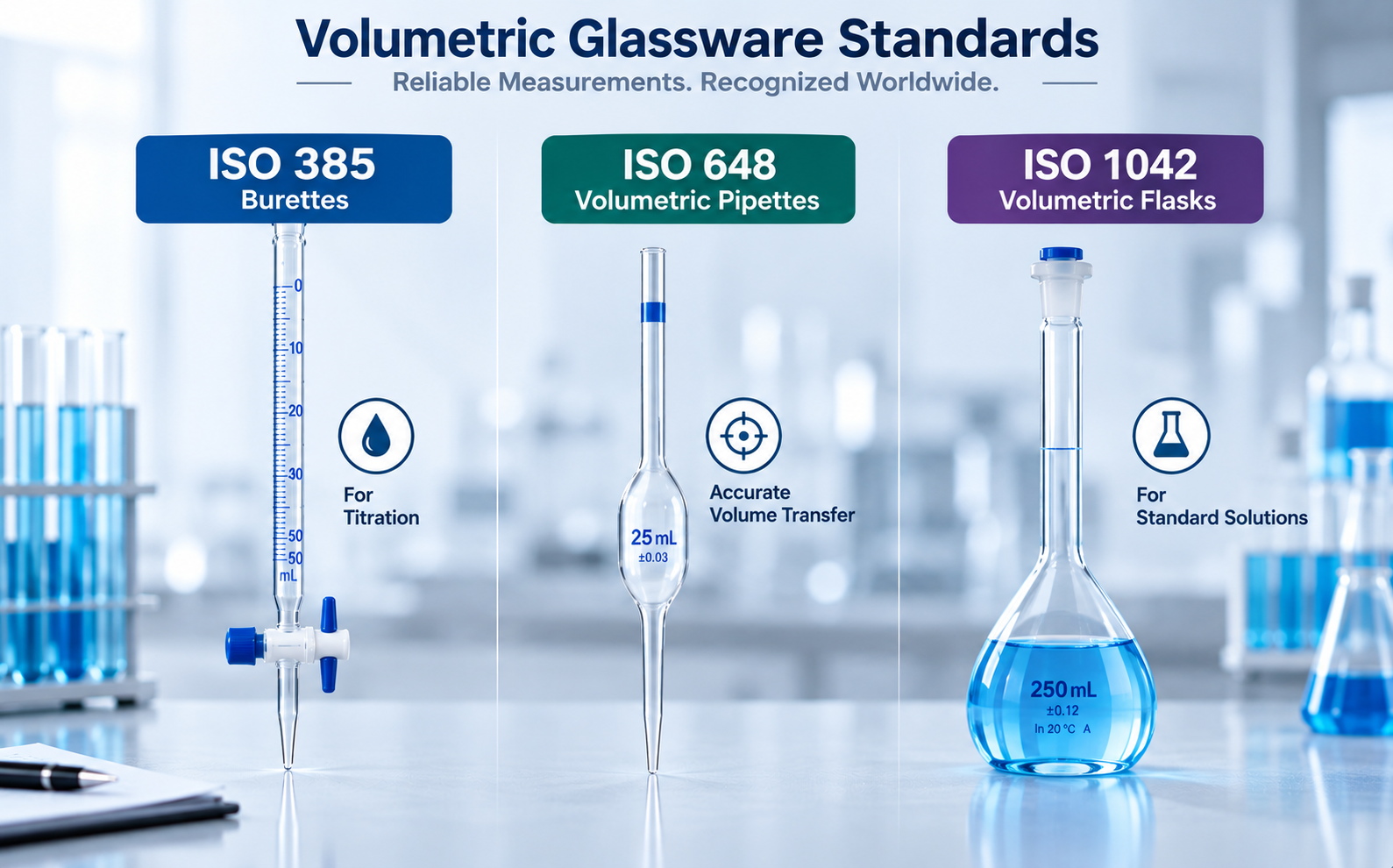
Examples include ISO 385 for burettes, ISO 648 for single-volume pipettes and ISO 1042 for one-mark volumetric flasks.
Why Is Borosilicate 3.3 Used in Laboratory Glassware?
Many high-quality laboratory glass products are manufactured from borosilicate 3.3 glass because it provides:
- low thermal expansion,
- good thermal shock resistance,
- high hydrolytic resistance,
- good resistance to many chemicals,
- excellent transparency.
However, borosilicate glass is not universally resistant to every chemical or condition.
Hydrofluoric acid, for example, can severely attack glass.
Can All Laboratory Glassware Be Heated?
No.
Suitable borosilicate beakers, Erlenmeyer flasks and round-bottom flasks may be used for heating under appropriate conditions.
Calibrated volumetric glassware such as:
- volumetric flasks,
- volumetric pipettes,
- burettes
should not be treated as general heating vessels.
Always follow the manufacturer's instructions and temperature limitations.
Why Are Scratches and Cracks Important?
Cracks, deep scratches, chips and edge damage can reduce the mechanical strength of glassware.
The risk becomes particularly important during:
- heating,
- vacuum operation,
- pressure exposure,
- rapid temperature changes.
Damaged glassware should be inspected and removed from service when its integrity is compromised.
How Should Laboratory Glassware Be Selected?
A useful selection sequence is:
Application → Capacity → Required Accuracy → Glass Type → Chemical Compatibility → Temperature → Pressure/Vacuum → Connection Type
Examples:
Titration → Burette + Erlenmeyer Flask
Standard solution preparation → Volumetric Flask + Appropriate Pipette
Distillation → Round-Bottom Flask + Condenser
Liquid-liquid extraction → Separatory Funnel
Vacuum filtration → Kitasato Flask + Büchner Funnel
Moisture protection → Desiccator
Common Laboratory Glassware Mistakes
Common mistakes include:
- Using a beaker for accurate volume measurement.
- Treating Erlenmeyer graduations as volumetric calibration.
- Directly heating volumetric flasks.
- Using standard Erlenmeyer flasks under vacuum.
- Assuming the organic layer is always above the aqueous layer.
- Heating cracked or damaged glassware.
- Rapidly cooling hot glassware.
- Ignoring chemical compatibility.
- Ignoring accuracy classes for volumetric glassware.
- Applying pressure or vacuum to glassware not designed for that purpose.
Conclusion
Selecting and using laboratory glassware correctly is important for both analytical reliability and laboratory safety.
Beakers and Erlenmeyer flasks provide versatility for general laboratory work, while volumetric flasks, pipettes and burettes are designed for accurate volumetric procedures. Round-bottom flasks and condensers form the basis of many distillation and reflux systems, while separatory funnels are designed for extraction, Kitasato flasks for vacuum filtration and desiccators for moisture control.
The key question when selecting laboratory glassware should therefore be:
“What procedure was this piece of glassware designed to perform?”
Using the right glassware for the right application helps laboratories work more safely, efficiently and reliably.