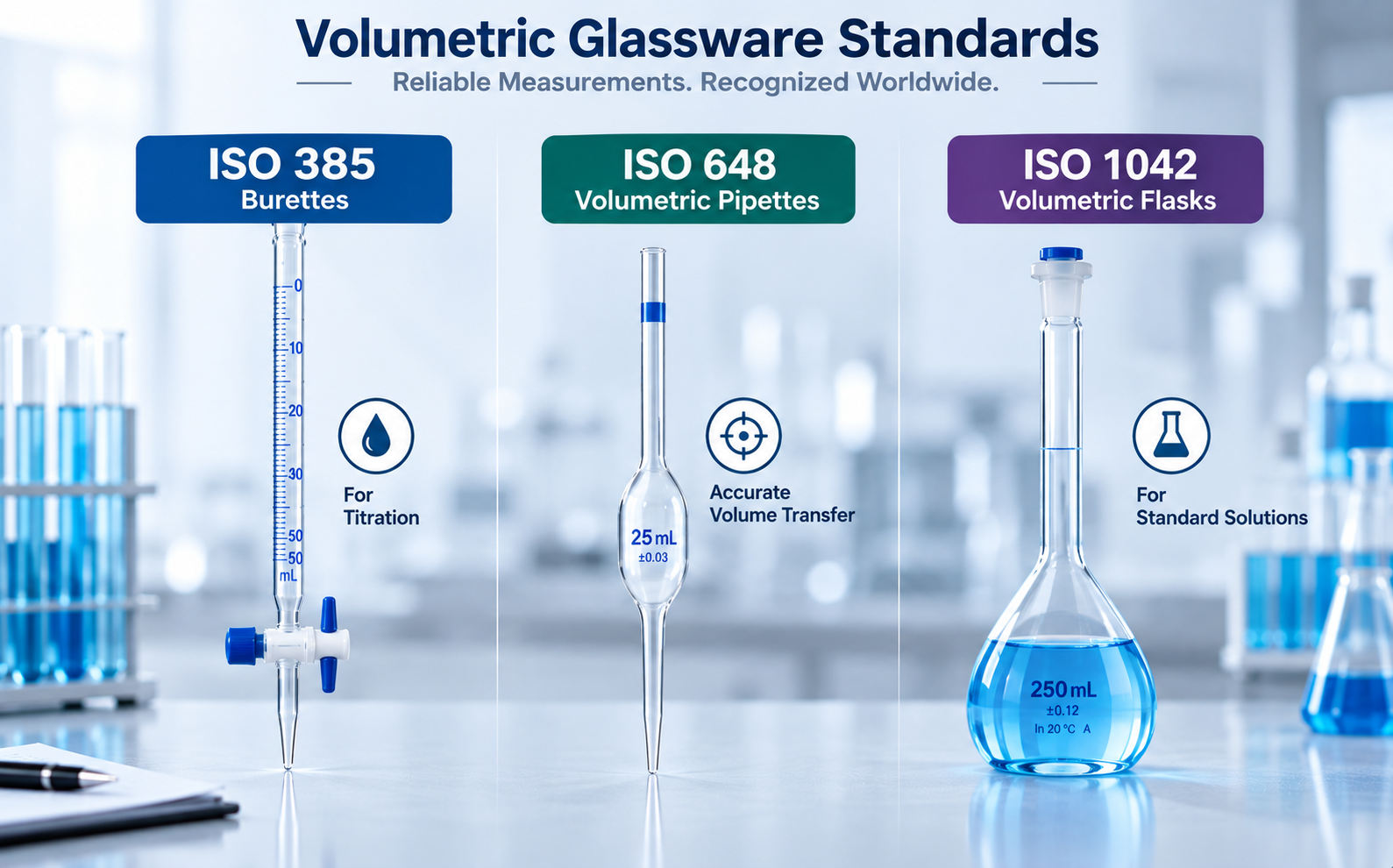
A volumetric flask is one of the most important pieces of volumetric laboratory glassware. It is designed to prepare a specific final liquid volume with high accuracy. It is widely used for standard solutions, analytical dilutions, calibration solutions and the preparation of solutions with accurately defined concentrations. Unlike a beaker or graduated cylinder, a volumetric flask is generally designed for one nominal volume. For example, a 250 mL volumetric flask is intended to prepare a final volume of 250 mL under its specified calibration conditions.

What Is a Volumetric Flask?
A volumetric flask typically consists of:
- A wide bulb-shaped body
- Flat base
- Long, narrow neck
- Single calibration mark
- Nominal volume marking
- Calibration temperature
- Accuracy/tolerance information
- Suitable stopper
Common capacities include 10, 25, 50, 100, 200, 250, 500, 1000 and 2000 mL, among others.
What Is It Used For?
Typical applications include:
- Preparing standard solutions
- Preparing solutions of defined concentration
- Diluting samples to a specified final volume
- Analytical dilutions
- Preparing titration solutions
- Preparing calibration standards
- Quantitative chemical analysis
Why Does It Have a Narrow Neck?
The narrow neck improves the ability to set the liquid level accurately.
A small change in volume creates a noticeable change in liquid height within the narrow neck.
This makes it easier to align the meniscus precisely with the calibration mark.
Narrow Neck → More Precise Meniscus Adjustment
What Does the Calibration Mark Mean?
The single mark on the neck indicates the reference liquid level for the flask's nominal contained volume under its specified calibration conditions.
For example:
250 mL Flask → Meniscus at the Mark = Nominal 250 mL Volume
The calibration temperature and tolerance should also be considered for accurate work.
How to Prepare an Accurate Volume
A typical procedure involves:
1. Prepare the Material
Accurately measure the required quantity of solid or concentrated solution.
2. Dissolve the Material
When appropriate, dissolve the material in a suitable amount of solvent, often initially in a beaker.
3. Transfer to the Volumetric Flask
Carefully transfer the solution into the flask.
Where required, rinse the original vessel and transfer equipment with solvent and add the rinsings to achieve a quantitative transfer.
4. Add Solvent
Add solvent until the liquid approaches the calibration mark.
5. Adjust the Final Volume
As the meniscus approaches the mark, add solvent carefully using a dropper or suitable pipette.
6. Mix Thoroughly
Insert the stopper and carefully invert the flask several times to homogenize the solution.
How Should the Meniscus Be Read?
The curved liquid surface is called the meniscus.
For water and many aqueous solutions, a concave meniscus is observed.
The volume is generally adjusted so that:
The bottom of the meniscus aligns with the calibration mark.
The eye must be at the same level as the mark.
What Is Parallax Error?
Parallax error occurs when the liquid level is viewed from above or below rather than directly at eye level.
The meniscus can then appear higher or lower than its actual position.
Correct reading therefore requires:
Eye Level + Meniscus + Calibration Mark
Volumetric Flask vs. Graduated Cylinder
| Feature | Volumetric Flask | Graduated Cylinder |
|---|---|---|
| Primary purpose | Preparing a defined final volume | Measuring different liquid volumes |
| Calibration | Usually one mark | Multiple graduations |
| Shape | Wide body, narrow neck | Tall cylinder |
| Accuracy | Generally higher | Generally lower |
| Solution preparation | Excellent | Limited |
| Measuring multiple volumes | Not suitable | Suitable |
A 250 mL volumetric flask should therefore not be used to measure 100, 150 or 200 mL.
Volumetric Flask vs. Beaker
A beaker is primarily used for:
- Dissolving
- Mixing
- Heating
- Liquid transfer
A volumetric flask is used for:
Preparing an accurately defined final volume
A solution may therefore first be dissolved in a beaker and then quantitatively transferred to a volumetric flask for final volume adjustment.
Class A vs. Class B
Volumetric glassware may be manufactured to different tolerance classes.
Class A
Generally provides tighter tolerances and is preferred for higher-accuracy analytical work.
Class B
Generally has wider tolerances and may be suitable for routine laboratory applications.
Exact tolerances depend on the nominal capacity and applicable standard.
Why Does Calibration Temperature Matter?
Volumetric glassware is calibrated at a defined reference temperature, commonly 20 °C for laboratory glassware.
Temperature can affect both the container and the liquid volume.
For high-accuracy work, the flask and solution should therefore be reasonably equilibrated to the relevant calibration conditions.
Should a Hot Solution Be Made Up to the Mark?
For accurate volumetric preparation, a hot solution should generally not be immediately adjusted to the calibration mark.
As the solution cools, its volume can change.
A better approach is:
- Dissolve the material.
- Allow the solution to reach an appropriate temperature.
- Transfer it to the volumetric flask.
- Adjust the final volume.
Can a Volumetric Flask Be Heated?
A volumetric flask is a measurement and solution-preparation vessel, not a heating vessel.
It should generally not be directly heated on a hotplate or over a flame.
Use appropriate laboratory glassware designed for heating when required.
What Happens If You Fill Above the Mark?
If too much solvent is added, the final volume becomes larger than intended while the amount of analyte remains unchanged.
Consequently:
The concentration becomes lower than intended.
For this reason, solvent should be added very carefully as the liquid approaches the calibration mark.
Can Overfilling Be Corrected by Removing Some Solution?
For accurately prepared solutions, simply removing excess liquid does not reliably correct an overfilled flask.
The removed solution also contains part of the analyte.
For high-accuracy analytical work, the solution may need to be prepared again according to the applicable procedure.
What Should You Consider When Choosing a Volumetric Flask?
Important criteria include:
- Nominal capacity
- Class A or Class B
- Tolerance
- Applicable standard
- Calibration temperature
- Glass or plastic construction
- Chemical compatibility
- Stopper type
- Clear or amber glass
- Manufacturer's calibration information
Common Mistakes
Typical errors include:
- Incorrect meniscus reading
- Reading above or below eye level
- Filling above the calibration mark
- Adjusting hot solutions to final volume
- Heating the volumetric flask
- Adjusting volume before complete dissolution
- Inadequate mixing after dilution
- Incomplete quantitative transfer
- Selecting an inappropriate tolerance class
- Using the flask to measure intermediate volumes
Quick Summary
Accurate volumetric preparation can be summarized as:
Measure → Dissolve → Transfer → Equilibrate → Make Up to the Mark → Mix
The fundamental rule for final adjustment is:
Eye Level + Meniscus + Calibration Mark
Conclusion
A volumetric flask is designed to prepare a specific final volume with high accuracy.
While a beaker is primarily used for preparation, mixing and heating, and a graduated cylinder is used to measure different liquid volumes, the volumetric flask is designed specifically to prepare one accurately defined nominal volume.
For reliable results, consider:
Correct Flask + Appropriate Temperature + Correct Meniscus + Eye-Level Reading
In standard-solution preparation and analytical dilution, even a small volume error can directly affect the final concentration.