
Selecting laboratory equipment is not simply a matter of comparing specifications and purchasing the instrument with the highest performance figures. The right instrument should be suitable for the analytical method, provide the required accuracy and precision, handle the laboratory's sample workload, offer reliable technical support and remain sustainable throughout its service life. Although balances, pH meters, microscopes, refractometers, spectrophotometers, ovens and incubators have different technical requirements, several fundamental selection criteria apply to almost all laboratory equipment. Here are the 10 critical criteria to consider when selecting laboratory equipment.
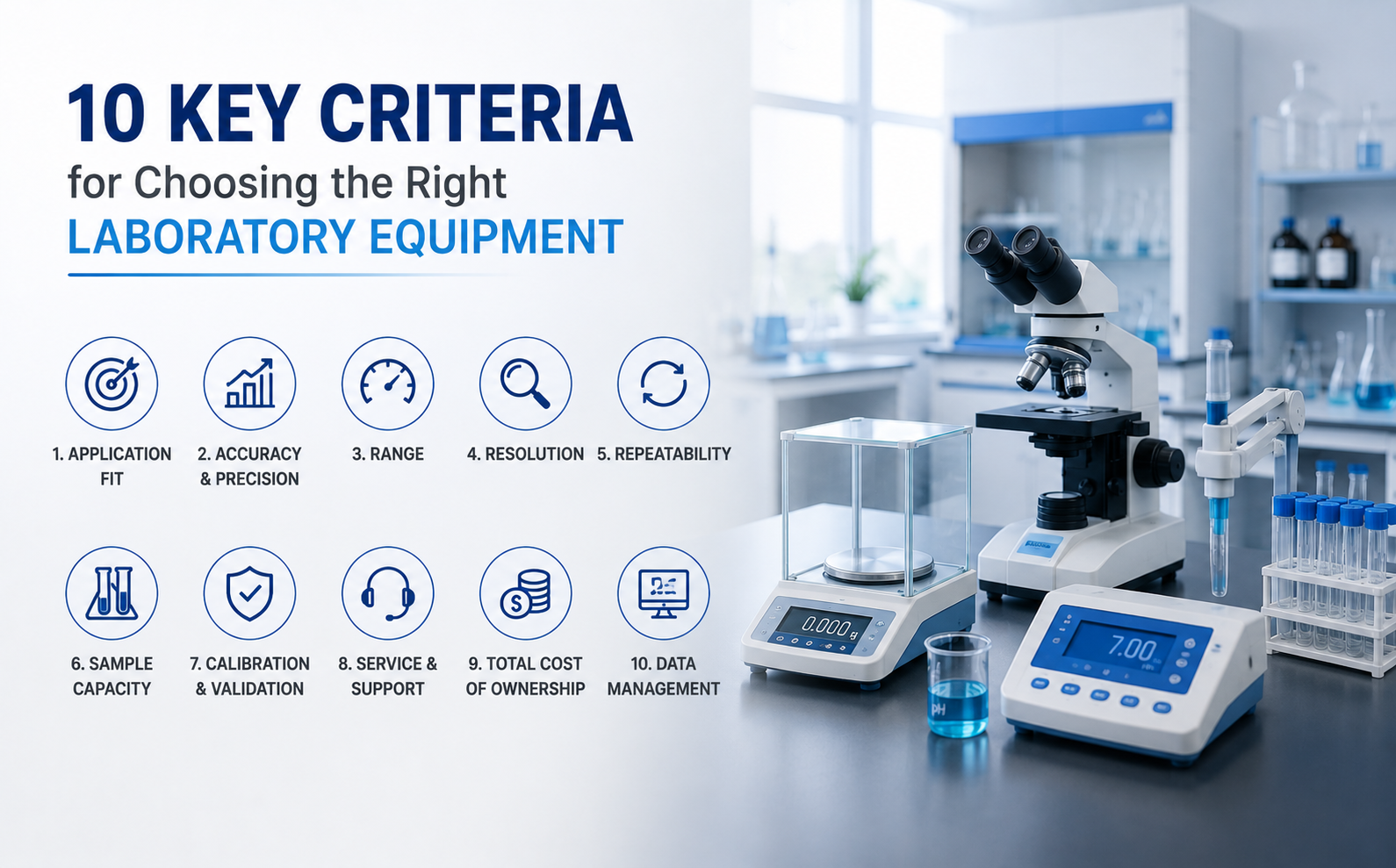
1. Define the Application Before Selecting the Instrument
The first question should not be:
“Which instrument should we buy?”
Instead, ask:
“Which analysis or process do we need to perform?”
Define:
- the parameter to be measured,
- sample type,
- analytical method,
- expected measurement range,
- required accuracy,
- daily sample volume.
The recommended sequence is:
Application → Method → Technical Requirement → Instrument
This approach helps prevent both under-specification and unnecessary over-specification.
2. Check the Measurement Range
The measurement range defines the values within which an instrument can operate.
Examples include:
- weighing capacity of a balance,
- Brix range of a refractometer,
- temperature range of an oven,
- wavelength range of a spectrophotometer.
The range should comfortably cover the expected sample values.
However, a wider range is not automatically better. It should primarily be appropriate for the actual application.
3. Understand Accuracy and Precision
Accuracy and precision are related but different concepts.
Accuracy
How close a measurement is to an accepted reference or true value.
Precision
How closely repeated measurements agree with one another.
An instrument may produce highly consistent measurements that are systematically different from the reference value.
Therefore, do not evaluate instrument performance solely by the number of digits displayed.
4. Resolution Is Not the Same as Accuracy
Resolution is the smallest change that an instrument can display or distinguish.
For example, a balance may display:
0.001 g
increments.
This does not necessarily mean that every measurement is accurate to ±0.001 g.
Resolution, accuracy and repeatability should therefore be evaluated separately.
This principle applies to balances, pH meters, refractometers, thermometers, spectrophotometers and many other instruments.
5. Evaluate Repeatability
Laboratory measurements should not only be accurate once; repeated measurements under the same conditions should also provide consistent results.
Repeatability is particularly important in routine quality-control applications.
Variations between repeated measurements can originate from:
- instrument performance,
- sample preparation,
- environmental conditions,
- operator technique.
The required level of repeatability should be determined according to the analytical method.
6. Calculate Sample Throughput
Instrument selection should consider laboratory workload as well as analytical performance.
Ask:
- How many samples are analyzed per day?
- How long does each measurement take?
- Is sample preparation required?
- Does the instrument require cleaning between samples?
- How many samples can be processed simultaneously?
- Is sample volume expected to increase?
A laboratory analyzing five samples per day may require a very different configuration from a QC laboratory processing hundreds of samples.
Future growth should also be considered without unnecessarily oversizing the system.
7. Check Calibration and Verification Requirements
The performance of measuring instruments must be controlled over time.
Depending on the instrument and quality system, this may involve:
- calibration,
- verification,
- performance checks,
- reference standards.
Before purchasing, determine:
How is the instrument calibrated?
Which standards are required?
Can the user perform calibration?
Is authorized service required?
Can appropriate calibration documentation be provided?
These questions are especially important in laboratories operating under frameworks such as ISO/IEC 17025, GMP or GLP.
8. Evaluate Technical Service and Spare-Part Availability
An instrument with excellent specifications provides little value if it remains out of service for months after a failure.
Before purchasing, evaluate:
- local technical support,
- service response,
- spare-part availability,
- preventive maintenance,
- installation support,
- user training.
For instruments used in critical analyses, technical support should be considered an essential purchasing criterion.
9. Calculate Consumable and Total Ownership Costs
Purchase price is only part of the true cost of laboratory equipment.
Throughout its lifetime, an instrument may require:
- electrodes,
- probes,
- lamps,
- cuvettes,
- filters,
- sensors,
- columns,
- reagents,
- calibration standards,
- replacement components.
A more realistic calculation is:
Total Cost of Ownership
Purchase + Consumables + Calibration + Maintenance + Service + Spare Parts + Energy + Software
An instrument that appears inexpensive initially may become more costly over its lifetime.
10. Evaluate Data Management and Connectivity
Modern laboratories increasingly require measurement results to be stored, transferred and integrated into digital workflows.
Depending on the application, useful connectivity may include:
- USB,
- Ethernet,
- Wi-Fi,
- Bluetooth,
- RS-232,
- PC software,
- printer connectivity,
- data export.
Advanced laboratories may also require integration with a LIMS (Laboratory Information Management System) or other data-management platforms.
Data traceability and integrity can be particularly important in regulated and quality-control environments.
Bonus: Consider Ease of Use
A technically advanced instrument can still be inefficient if routine operation is unnecessarily complicated.
Evaluate:
- display readability,
- menu structure,
- sample loading,
- cleaning,
- calibration procedures,
- result storage,
- multi-user functionality,
- training requirements.
Ease of use becomes especially important when several operators share the same instrument.
Does Brand Matter?
Brand should not be the only selection criterion.
However, the manufacturer's experience can influence:
- product quality,
- technical documentation,
- measurement reliability,
- spare-part continuity,
- software support,
- service infrastructure.
A better approach is to evaluate:
Manufacturer + Instrument Performance + Local Support + Long-Term Sustainability
together.
Price or Performance?
The cheapest instrument is not necessarily the most economical.
Similarly, the most expensive instrument is not automatically the best choice.
Buying an instrument with performance far beyond the requirements of the analytical method can create unnecessary investment costs.
The goal should be:
The optimum balance between required performance and total cost.
Prepare a Technical Specification Before Purchasing
Before comparing manufacturers, create a basic technical specification.
| Criterion | Requirement |
|---|---|
| Application | Intended analysis |
| Sample | Sample type |
| Measurement range | Required range |
| Accuracy | Method requirement |
| Resolution | Required value |
| Repeatability | Acceptance criterion |
| Capacity | Samples/day |
| Calibration | Requirements |
| Data transfer | USB / PC / LIMS etc. |
| Service | Local support |
| Warranty | Required period |
| Training | Required / Not required |
This makes it much easier to compare different instruments objectively.
Questions to Ask Before Purchasing Laboratory Equipment
Before making a final decision, ask the supplier:
- Is the instrument suitable for our application and sample type?
- What is its measurement range?
- What are its accuracy and repeatability specifications?
- How is it calibrated?
- Which consumables are required?
- Are consumables and spare parts readily available?
- Is local technical service available?
- Are installation and user training provided?
- Can measurement data be exported?
- What support is available after the warranty period?
These questions reveal the true operational value of an instrument beyond its purchase price.
10 Critical Criteria – Quick Summary
| # | Criterion |
|---|---|
| 1 | Application and method suitability |
| 2 | Measurement range |
| 3 | Accuracy and precision |
| 4 | Resolution |
| 5 | Repeatability |
| 6 | Sample throughput |
| 7 | Calibration and verification |
| 8 | Technical service and spare parts |
| 9 | Consumables and total ownership cost |
| 10 | Data management and connectivity |
Conclusion
Choosing the right laboratory equipment does not mean purchasing the model with the highest specifications.
The ideal instrument should be:
application-appropriate + sufficiently accurate + repeatable + adequately sized + calibratable + well supported + sustainable over the long term.
Instead of asking only:
“How much does this instrument cost?”
laboratories should ask:
“Can this instrument perform our analysis reliably, efficiently and sustainably?”
The right equipment decision can influence not only today's laboratory performance but also analytical reliability, operating costs and productivity for many years.

