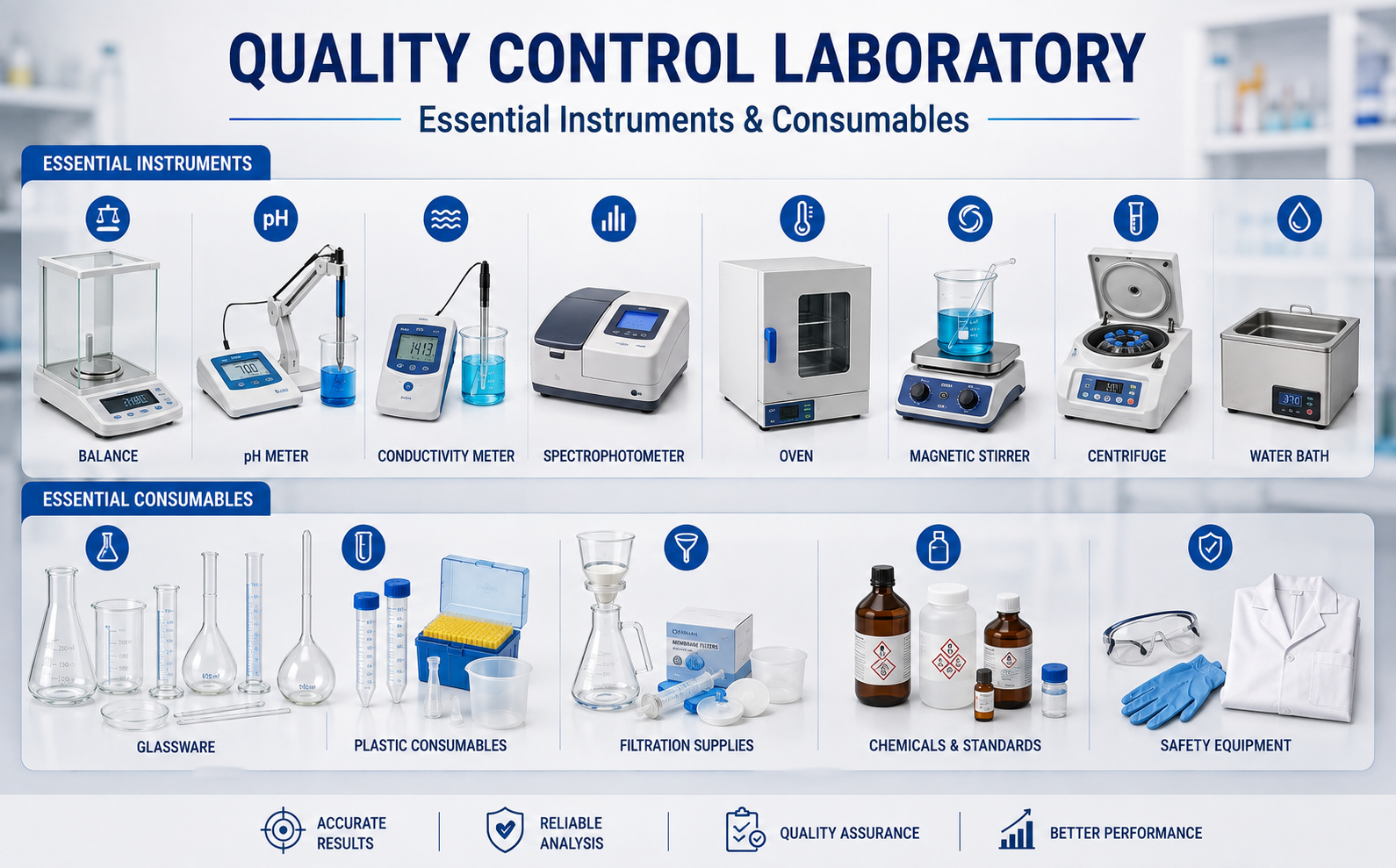
Quality control laboratories are used to verify whether raw materials, intermediate products and finished products meet defined quality requirements. They play an important role in pharmaceutical, chemical, food, cosmetics, environmental and many other industries. A well-equipped QC laboratory requires more than sophisticated analytical instruments. Measuring instruments, glassware, plastic consumables, chemicals and safety equipment must all be selected according to the intended analytical methods.
1. Analytical Balance
An analytical balance is one of the fundamental instruments in a QC laboratory. It is used for accurate weighing during sample, reagent and standard preparation, as well as gravimetric analysis.
Depending on the application, balances with 0.1 mg or other readability levels may be required.
2. pH Meter
A pH meter determines the acidity or alkalinity of solutions.
It is widely used in chemical, pharmaceutical, food, cosmetic and water-testing laboratories. Regular calibration using appropriate buffer solutions is important for reliable measurements.
3. Conductivity / EC Meter
Conductivity meters measure the electrical conductivity of solutions and are commonly used for:
- purified water testing
- process water analysis
- environmental testing
- chemical solution control
Some instruments combine EC, TDS and temperature measurements.
4. Spectrophotometer
UV-Vis spectrophotometers measure absorbance or transmittance at selected wavelengths.
Typical applications include:
- concentration determination
- colour analysis
- chemical testing
- reaction monitoring
- routine QC analysis
The required wavelength range and instrument specifications should be selected according to the analytical method.
5. Laboratory Oven
Laboratory ovens provide controlled heating and drying.
They can be used for sample drying, moisture-related procedures, glassware drying and specified temperature tests.
Temperature range, uniformity and control accuracy are important selection criteria.
6. Magnetic Stirrer and Hotplate Stirrer
Magnetic stirrers are widely used for homogeneous solution preparation.
Hotplate stirrers combine mixing and controlled heating and are useful for preparing standard solutions, buffers and reagents.
7. Centrifuge
Centrifuges help separate sample components according to differences in density.
Important selection criteria include:
- maximum RPM
- RCF
- rotor design
- tube capacity
- sample volume
8. Water Bath
Water baths maintain samples at controlled temperatures and provide uniform heating for many routine laboratory procedures.
9. Microscope
A microscope is not required in every QC laboratory, but it can be essential where particles, surfaces, fibres, crystals or microbiological samples must be examined.
Stereo, biological or other microscope systems can be selected according to the application.
10. Advanced Analytical Instruments
Depending on the industry and analytical requirements, a QC laboratory may also require:
- HPLC
- GC
- FTIR
- refractometer
- moisture analyzer
- density meter
- viscometer
- melting point apparatus
The required instruments should always be determined by the product specifications and analytical methods.
Essential Laboratory Glassware
Typical QC glassware includes:
- beakers
- Erlenmeyer flasks
- volumetric flasks
- graduated cylinders
- pipettes
- burettes
- test tubes
- reagent bottles
- funnels
- watch glasses
- glass stirring rods
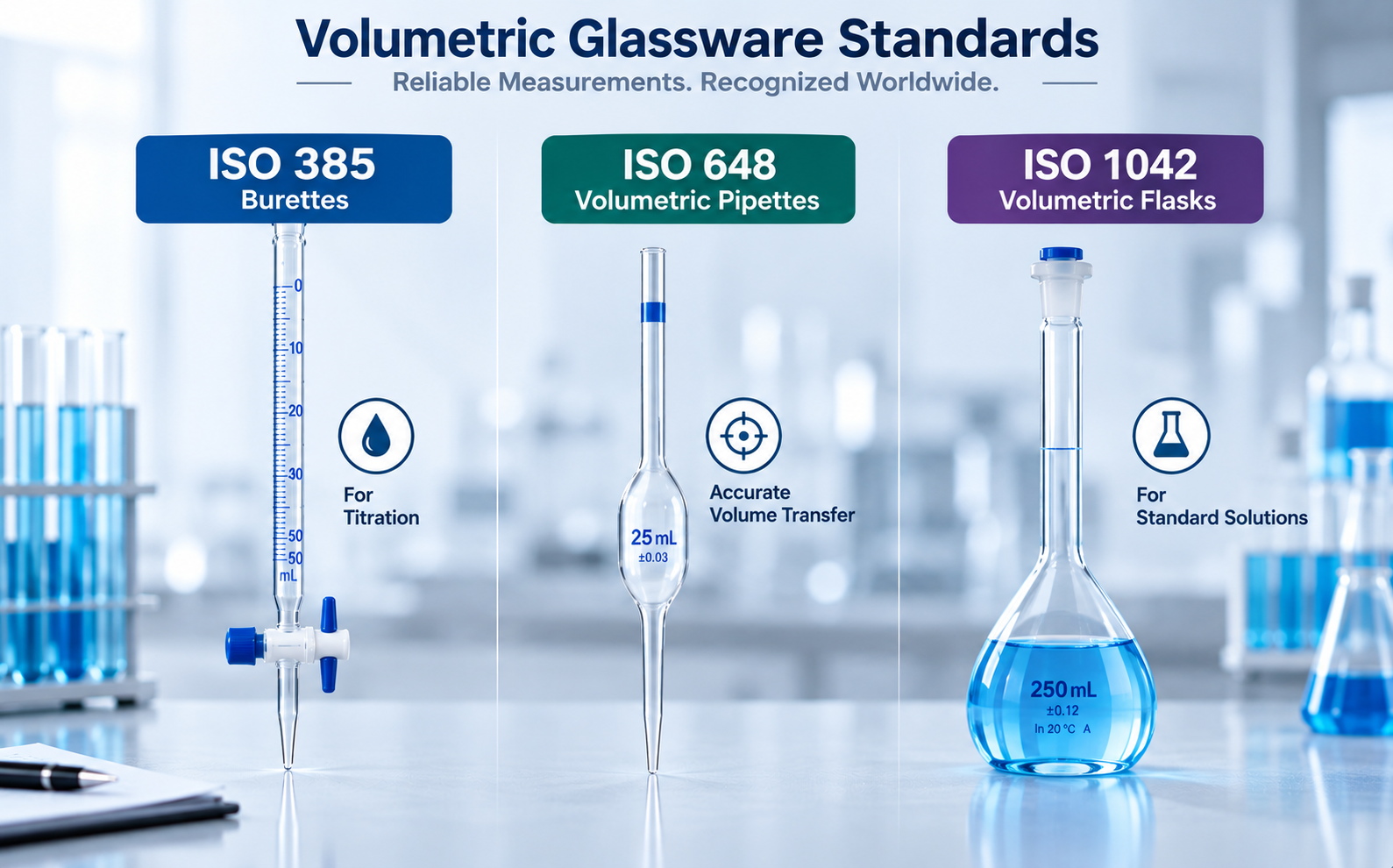
For quantitative analysis, appropriate accuracy classes should be selected for volumetric flasks, pipettes and burettes.
Plastic Consumables
Common laboratory consumables include:
- pipette tips
- centrifuge tubes
- sample containers
- plastic bottles
- wash bottles
- plastic beakers and cylinders
- disposable transfer pipettes
The chemical compatibility of PP, PE, HDPE and other materials with the sample and reagents should always be considered.
Filtration Supplies
Depending on the analytical procedures, laboratories may require:
- filter papers
- membrane filters
- syringe filters
- glass funnels
- Büchner funnels
- vacuum filtration systems
For instrumental methods such as HPLC, selecting the appropriate membrane material and pore size can be particularly important.
Chemicals and Standards
QC laboratories may use:
- acids and bases
- buffer solutions
- indicators
- solvents
- titration solutions
- reference standards
- calibration solutions
Grades such as ACS, ISO, Ph. Eur., USP and HPLC should be selected according to the requirements of the analytical method.
Calibration and Control Materials
Reliable QC requires more than simply purchasing instruments.
Depending on the application, laboratories may need:
- certified reference weights
- pH buffers
- conductivity standards
- temperature references
- volumetric control equipment
- certified reference materials
Calibration and verification programs should reflect instrument use, manufacturer recommendations, risk assessment and the laboratory's quality system.
Laboratory Safety Equipment
Depending on the laboratory risk assessment, essential safety equipment may include:
- safety glasses
- appropriate chemical-resistant gloves
- laboratory coats
- fume hoods
- eyewash stations
- emergency safety showers
- spill kits
- suitable waste containers
How Should a QC Laboratory Be Planned?
Before purchasing equipment, laboratories should first define the analyses they need to perform.
A practical planning sequence is:
Product → Analytical Method → Instrument → Glassware & Consumables → Chemicals → Calibration → Safety
This helps prevent unnecessary equipment purchases while ensuring that essential items are not overlooked.
Conclusion
An effective quality control laboratory depends on more than advanced analytical instruments. Balances, pH meters, glassware, filtration products, chemicals, standards and calibration materials must work together as a complete analytical system.
By defining analytical methods first and selecting equipment accordingly, laboratories can create a stronger foundation for reliable measurements, reproducible results, efficient workflows and effective quality control.