
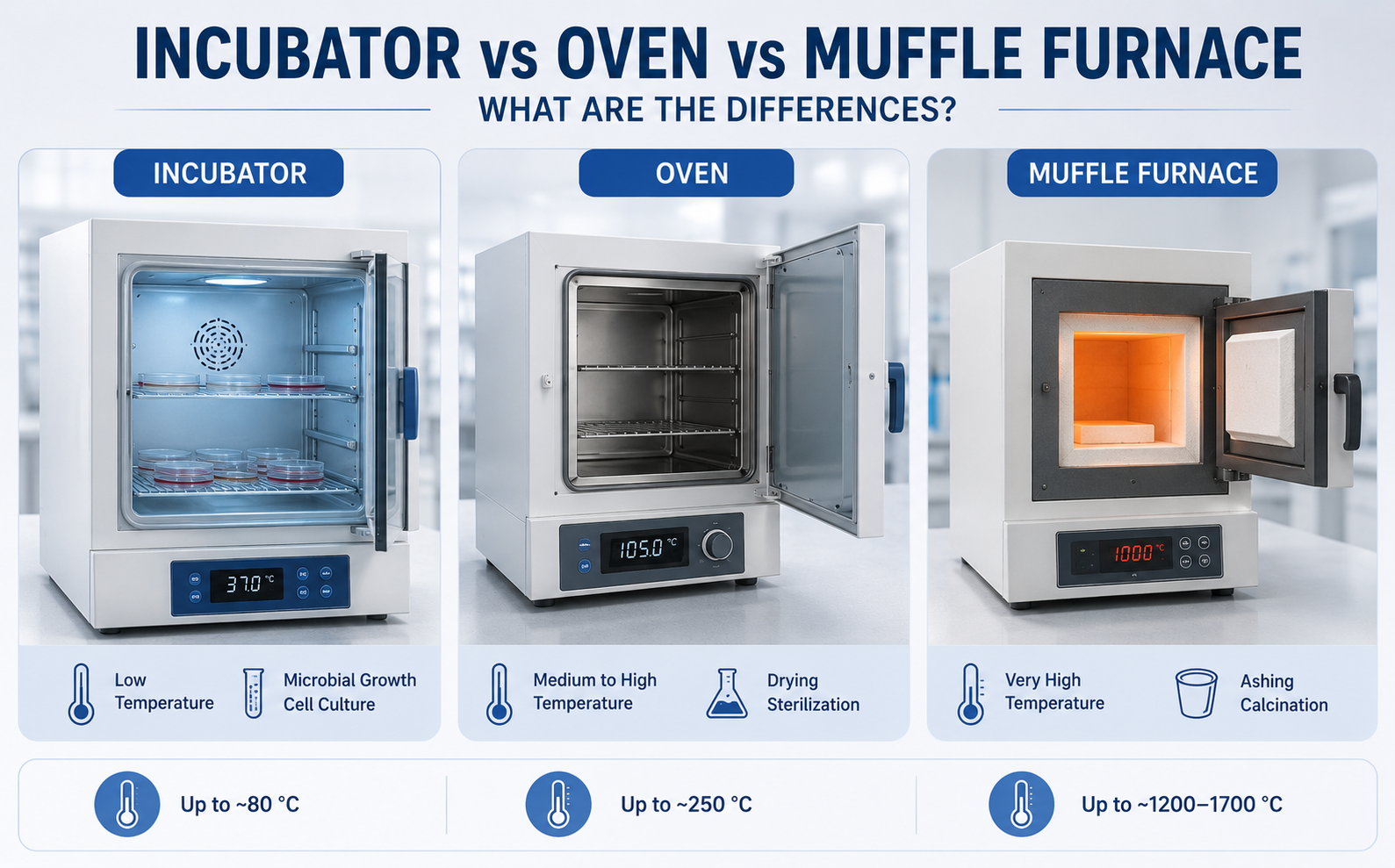
Laboratories use different types of temperature-controlled equipment depending on the application. Although incubators, laboratory ovens and muffle furnaces may appear to perform similar functions, they differ significantly in temperature range, design and intended use. ncubators are designed for maintaining controlled temperatures, laboratory ovens are primarily used for heating and drying, and muffle furnaces are designed for high-temperature applications such as ashing and ignition.
What Is a Laboratory Incubator?
A laboratory incubator maintains samples at a controlled and stable temperature for a specified period.
It is particularly important in biological and microbiological applications.
Typical uses include:
- microbial incubation
- microbiological testing
- food and water analysis
- quality-control procedures
- controlled-temperature sample storage
The primary objective is not to achieve extremely high temperatures but to maintain a stable and uniform temperature environment.
Depending on the method, temperatures such as 25 °C, 30 °C or 37 °C may be used in microbiological applications.
What Is a Laboratory Oven?
A laboratory oven uses controlled heated air for drying and heating samples or laboratory materials.
Common applications include:
- drying laboratory glassware
- drying samples
- moisture-related procedures
- controlled heat treatment
- quality-control testing
Laboratory ovens generally operate at higher temperatures than incubators.
Models may use natural convection or forced-air circulation depending on their design.
What Is a Muffle Furnace?
A muffle furnace is designed for laboratory processes requiring very high temperatures.
Depending on the model, muffle furnaces may reach approximately 1000 °C, 1100 °C, 1200 °C or higher.
Typical applications include:
- ash determination
- combustion of organic material
- certain mineralization procedures
- ceramic and material testing
- high-temperature heat treatment
- sample preparation for gravimetric analysis
They are commonly used in food, chemical, environmental, mining, cement and materials laboratories.
Incubator vs. Oven vs. Muffle Furnace
| Feature | Incubator | Laboratory Oven | Muffle Furnace |
|---|---|---|---|
| Main purpose | Incubation | Drying and heating | High-temperature treatment |
| Temperature level | Low/medium | Medium/high | Very high |
| Microbiology | Highly suitable | Not the primary purpose | Not suitable |
| Glassware drying | Generally not preferred | Suitable | Not suitable |
| Ash determination | Not suitable | Not suitable | Suitable |
| Sample ignition | Not suitable | Generally unsuitable | Suitable |
| Main priority | Temperature stability | Controlled drying | High temperature |
Exact operating temperatures depend on the instrument model and manufacturer specifications.
Why Is a Muffle Furnace Used for Ash Determination?
Some analytical procedures require more than simply removing moisture.
During ash determination, organic material is removed at high temperature, leaving inorganic residue for further evaluation.
A conventional laboratory oven is not designed for these temperatures, so an appropriate muffle furnace is required.
Why Are Crucibles Used in Muffle Furnaces?
Standard laboratory glassware is generally not appropriate for the extreme temperatures used in muffle furnaces.
Depending on the application, crucibles may be manufactured from:
- porcelain,
- quartz,
- alumina,
- platinum,
- other high-temperature materials.
The crucible must be compatible with the required temperature, sample and chemical environment.
Can an Oven Replace an Incubator?
They should generally not be considered direct substitutes.
Although both provide controlled temperatures, they are designed for different purposes:
Incubator → Stable-temperature incubation
Laboratory Oven → Heating and drying
If a standardized analytical method specifies a particular type of equipment, the method requirements should be followed.
What Should You Consider When Choosing?
Important selection criteria include:
- operating temperature range
- temperature accuracy
- temperature stability
- temperature uniformity
- chamber capacity
- heating time
- controller type
- timer and programming functions
- over-temperature protection
- calibration options
For muffle furnaces, maximum operating temperature, refractory construction, programmable temperature ramps and ventilation requirements may also be important.
Which Instrument Should You Choose?
As a simple guide:
Microbiological incubation → Incubator
Sample or glassware drying → Laboratory Oven
Ash determination and high-temperature ignition → Muffle Furnace
The final choice should always be based on the analytical method, sample type and required operating conditions.
Conclusion
Incubators, laboratory ovens and muffle furnaces are three important types of temperature-controlled laboratory equipment, but they serve different purposes.
An incubator provides stable conditions for applications such as microbiological incubation.
A laboratory oven is designed primarily for controlled heating and drying.
A muffle furnace is used for ashing, ignition and other very high-temperature procedures.
Selecting the correct equipment helps laboratories achieve more reliable, repeatable and safe analytical results.

