
When selecting a laboratory balance, terms such as accuracy, precision, resolution, readability and repeatability frequently appear in technical specifications. Although these terms are related, they do not mean the same thing. A balance displaying more decimal places is not automatically more accurate. Reliable weighing depends on a combination of readability, repeatability, linearity, calibration and environmental conditions. Understanding these concepts is essential when selecting the appropriate balance for a laboratory application.
What Is Accuracy?
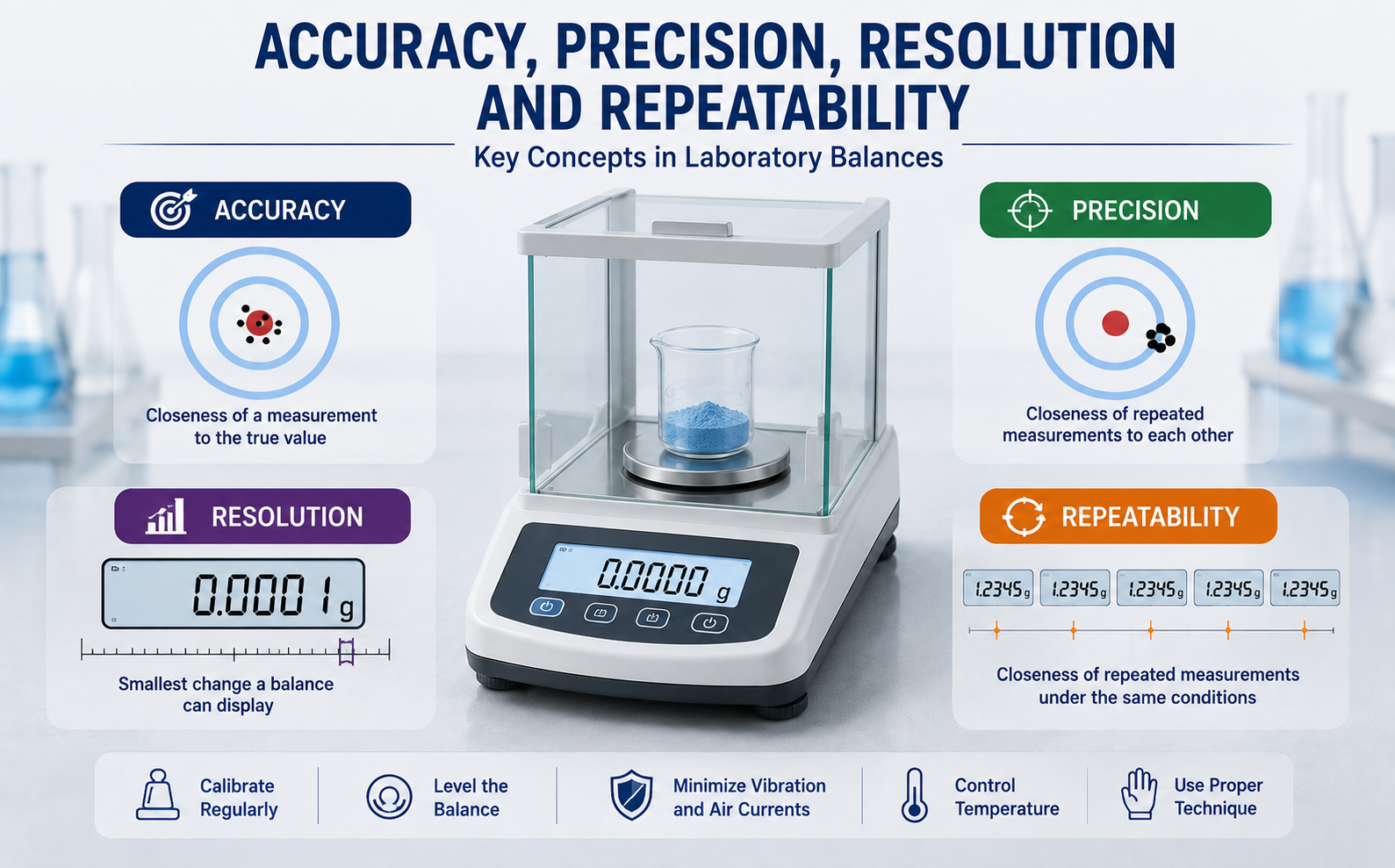
Accuracy generally describes how close a measured value is to an accepted or reference value.
For example, if a suitable reference weight has a certified value of 100.000 g, a properly performing balance should produce a result appropriately close to that value.
In metrology, however, accuracy is not normally treated as a single numerical specification by itself. Measurement error, uncertainty, repeatability, linearity and other performance characteristics are considered when evaluating measurement quality.
What Can Affect Weighing Accuracy?
Important factors include:
- calibration and adjustment,
- correct leveling,
- temperature changes,
- air currents,
- vibration,
- static electricity,
- eccentric loading,
- sample temperature,
- weighing technique,
- instrument performance.
Reliable weighing therefore requires both an appropriate balance and correct operating conditions.
What Is Precision?
In everyday laboratory language, precision is often used to describe the ability of a balance to detect and consistently measure small mass differences.
Technically, however, more specific specifications are preferable, including:
- readability,
- repeatability,
- linearity,
- sensitivity.
For this reason, instead of simply describing a balance as “highly precise,” its actual technical specifications should be examined.
What Are Resolution and Readability?
Readability (d) is one of the most important specifications of a digital laboratory balance.
It represents the smallest mass increment shown on the display.
| Balance Type | Readability | Smallest Display Increment |
|---|---|---|
| General balance | 1 g | 1 g |
| Precision balance | 0.1 g | 100 mg |
| Precision balance | 0.01 g | 10 mg |
| Precision balance | 0.001 g | 1 mg |
| Analytical balance | 0.0001 g | 0.1 mg |
A balance with 0.001 g readability, for example, can display mass changes in 1 mg increments.
However:
Readability is not accuracy.
A display showing 0.0001 g increments does not mean that every result is accurate to ±0.0001 g.
Resolution vs. Readability
These terms are sometimes used interchangeably in product descriptions.
For digital laboratory balances, readability usually refers specifically to the smallest displayed increment.
Resolution can be used more broadly to describe the instrument's ability to distinguish changes across its measurement range.
When comparing balances, checking the manufacturer's stated readability (d) is therefore important.
What Is Repeatability?
Repeatability describes how closely repeated measurements of the same load agree when performed under similar conditions.
For example, repeated measurements might produce:
- 100.001 g
- 100.000 g
- 100.001 g
- 100.000 g
- 100.001 g
The close agreement between these values indicates good repeatability.
Repeatability is particularly important for analytical balances.
Accuracy vs. Repeatability
A balance can provide highly repeatable results while still showing a systematic deviation from the reference value.
Suppose the reference value is 100.000 g and repeated results are:
- 100.020 g
- 100.021 g
- 100.020 g
- 100.020 g
The readings are close to one another, indicating good repeatability, but they are consistently displaced from the reference value.
In simple terms:
Repeatability → How close repeated results are to one another
Accuracy → General concept relating to closeness to the reference value
What Is Linearity?
Linearity is an important characteristic describing measurement performance at different load levels.
A 200 g balance should perform appropriately not only around 100 g but also at different points such as:
- 20 g,
- 50 g,
- 100 g,
- 150 g,
- 200 g.
Checking only one load point may therefore not provide complete information about performance across the weighing range.
What Is Eccentric Loading?
Eccentricity refers to the effect of placing a load at different positions on the weighing pan.
Ideally, samples should be positioned near the center of the pan.
This becomes especially important when large weighing vessels are used.
Eccentric-load testing may also form part of laboratory balance performance verification.
What Is Minimum Sample Weight?
Minimum sample weight is particularly important in analytical weighing.
An analytical balance may have:
0.0001 g readability
but this does not mean that:
0.0001 g can be reliably weighed as a sample.
Minimum sample weight depends on factors such as repeatability and the permitted relative uncertainty or tolerance of the weighing process.
It is especially important in pharmaceutical and other high-accuracy applications.
Example: A 0.0001 g Analytical Balance
Consider a balance with:
Maximum capacity: 220 g
Readability: 0.0001 g
Repeatability: 0.0001 g
Linearity: ±0.0002 g
These values describe different characteristics.
220 g → Maximum weighing capacity
0.0001 g readability → Smallest displayed increment
0.0001 g repeatability → Performance related to the spread of repeated measurements
±0.0002 g linearity → Specification related to measurement behaviour across different load levels
Simply describing the instrument as a “0.0001 g balance” therefore does not fully define its performance.
Why Is Calibration Important?
Balance performance should be evaluated using appropriate reference standards.
Calibration compares measurement results with traceable references and helps establish the instrument's measurement performance.
Depending on laboratory requirements, regular:
- intermediate checks,
- verification,
- performance tests
may also be performed.
Frequency should be determined according to use, required performance, quality-system requirements and risk.
Does Internal Calibration Automatically Mean Better Accuracy?
No.
An internal adjustment/calibration system can simplify routine operation and help adjust the balance under specified conditions.
However, the presence of an internal system alone does not mean that the balance is inherently more accurate than another instrument.
Overall performance still depends on repeatability, linearity, environmental stability, calibration status and correct use.
How Do Air Currents Affect Analytical Balances?
Analytical balances can detect extremely small mass changes and are therefore highly sensitive to air movement.
Air conditioning, open windows and movement around the laboratory can destabilize readings.
For this reason, analytical balances normally include a draft shield around the weighing pan.
Keeping the shield closed during measurement helps improve stability.
Why Is Vibration Important?
Vibration can prevent a balance from reaching a stable reading.
Common sources include:
- centrifuges,
- vortex mixers,
- shakers,
- pumps,
- compressors,
- nearby machinery,
- heavy foot traffic.
Analytical balances should be placed on solid, low-vibration surfaces. Dedicated anti-vibration weighing tables may be useful for demanding applications.
Can Temperature Differences Affect Weighing?
Yes.
Hot or cold samples can create air currents around the weighing vessel.
Rapid changes in room temperature may also affect balance performance.
For high-precision measurements, samples and the balance should be allowed to equilibrate under suitable laboratory conditions according to the analytical procedure.
Can Static Electricity Cause Weighing Errors?
Yes.
Plastic weighing vessels, filter papers, powders and low-humidity environments can generate static charge.
This may cause:
- unstable readings,
- slow stabilization,
- unexpected measurement bias.
Antistatic devices or ionization systems may be useful for demanding analytical applications.
Precision Balance vs. Analytical Balance
Precision balances generally offer:
- higher capacities,
- convenient routine weighing,
- somewhat lower sensitivity to environmental influences.
Analytical balances are designed for:
- lower readability values,
- detection of very small mass changes,
- high-precision analytical work.
The important question is therefore not which balance is “better,” but which balance is appropriate for the application.
What Specifications Should You Check?
| Specification | Why It Matters |
|---|---|
| Maximum capacity | Defines the maximum load |
| Readability | Smallest displayed increment |
| Repeatability | Indicates agreement between repeated measurements |
| Linearity | Indicates performance across different loads |
| Minimum weight | Important for reliable small-sample weighing |
| Calibration system | Supports performance control and adjustment |
| Stabilization time | Influences routine workflow |
| Operating environment | Determines sensitivity to air, vibration and temperature |
Are More Decimal Places Always Better?
No.
If an application requires only ±0.1 g, using a 0.0001 g analytical balance may be unnecessary.
Higher-performance balances can also require:
- more controlled environments,
- more careful operation,
- additional maintenance,
- longer stabilization.
The instrument should therefore match the actual measurement requirement.
Common Mistakes
Common mistakes include:
- Treating readability as accuracy.
- Assuming more decimal places always mean better results.
- Ignoring repeatability.
- Ignoring minimum sample weight.
- Failing to level the balance correctly.
- Weighing near air currents.
- Using a vibrating workbench.
- Weighing hot samples directly.
- Ignoring static electricity.
- Neglecting calibration and routine performance checks.
Quick Summary
Accuracy: General concept describing closeness of a measurement to a reference value.
Readability: The smallest mass increment shown on the display.
Precision: A broader term associated with the closeness of repeated measurements; specific technical specifications should be checked.
Repeatability: How closely repeated measurements agree under the same conditions.
Linearity: Measurement performance across different load levels.
Minimum Weight: The lowest sample quantity that can be weighed while meeting defined performance requirements.
Conclusion
Reliable laboratory weighing cannot be evaluated simply by counting the number of decimal places on a balance display.
A proper assessment should consider:
Capacity + Readability + Repeatability + Linearity + Minimum Weight + Calibration + Environmental Conditions
Particularly with analytical balances, small environmental effects such as air movement, vibration, temperature differences and static electricity can significantly influence results.
Selecting the appropriate balance and operating it under suitable conditions are essential for obtaining reliable, repeatable and traceable laboratory weighing results.