
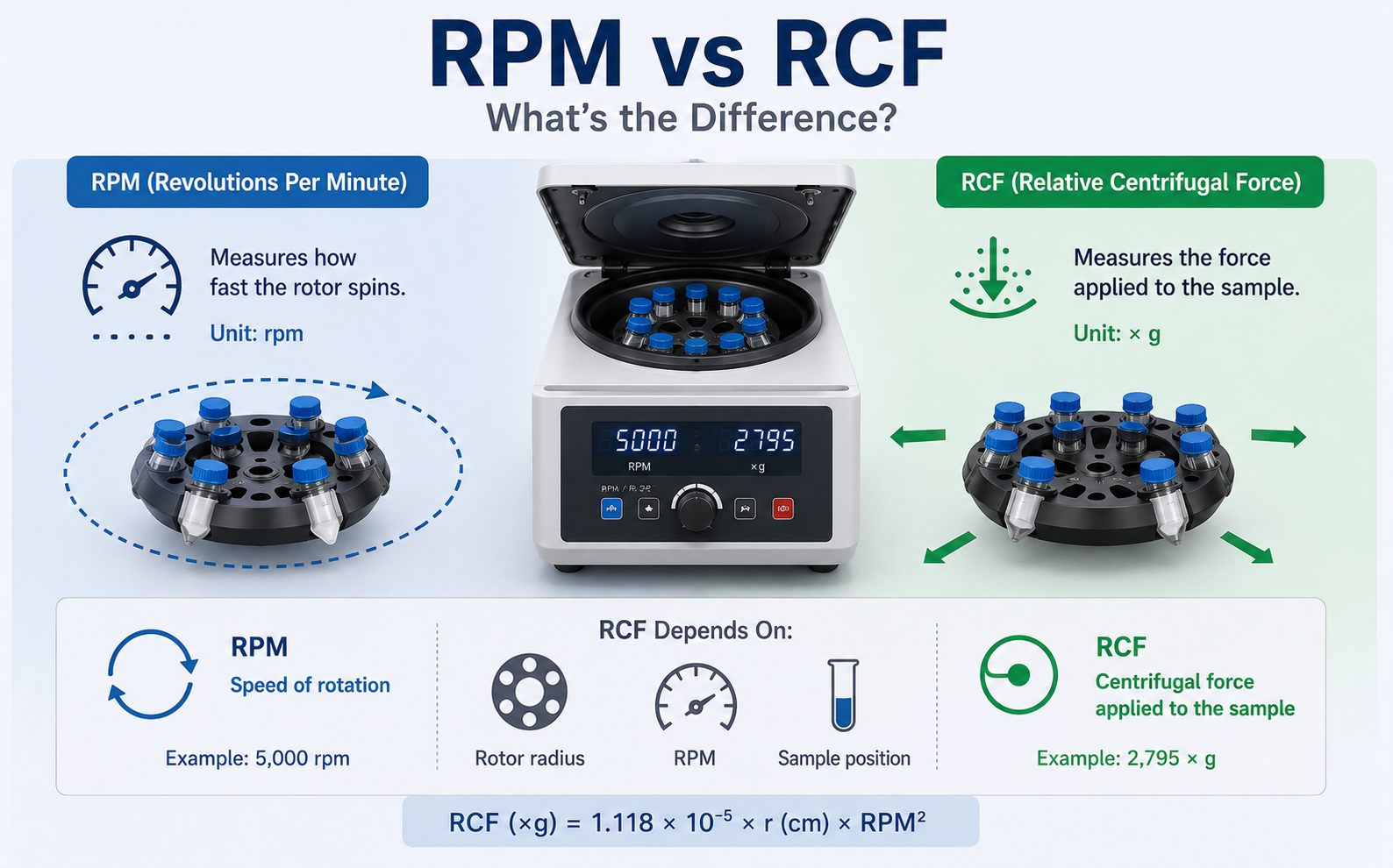
RPM and RCF are two of the most important parameters used in laboratory centrifugation. Although closely related, they do not represent the same thing. RPM describes how fast the rotor rotates, while RCF describes the centrifugal acceleration actually applied to the sample. Understanding the relationship between RPM, RCF and rotor radius is essential for accurate and reproducible centrifugation.
What Is RPM?
RPM – Revolutions Per Minute indicates how many complete rotations the rotor makes in one minute.
For example:
5,000 RPM = 5,000 rotor revolutions per minute
RPM describes rotational speed only. It does not directly indicate the centrifugal effect experienced by the sample.
What Is RCF?
RCF – Relative Centrifugal Force describes the centrifugal acceleration applied to the sample relative to Earth's gravitational acceleration.
It is commonly expressed as:
×g
For example:
10,000 ×g
means that the sample experiences centrifugal acceleration approximately 10,000 times the acceleration due to gravity.
What Is the Main Difference Between RPM and RCF?
The simplest explanation is:
RPM = How fast is the rotor spinning?
RCF = How much centrifugal acceleration is applied to the sample?
| Feature | RPM | RCF |
|---|---|---|
| Full term | Revolutions Per Minute | Relative Centrifugal Force |
| Represents | Rotational speed | Relative centrifugal acceleration |
| Expression | rpm | ×g |
| Depends on rotor radius | No | Yes |
| Directly represents sample effect | No | Yes |
| Useful for protocol transfer | Limited alone | Generally more useful |
Why Can the Same RPM Produce Different RCF?
RCF depends on both rotational speed and rotor radius.
A sample positioned farther from the axis of rotation experiences greater centrifugal acceleration at the same RPM.
Therefore:
Same RPM ≠ Same RCF
when rotor radii are different.
How Is RCF Calculated From RPM?
A commonly used equation is:
RCF = 1.118 × 10⁻⁵ × r × RPM²
where:
- RCF = relative centrifugal force (×g)
- r = rotor radius in centimetres
- RPM = revolutions per minute
Example Calculation
For a rotor radius of 10 cm operating at 5,000 RPM:
RCF = 1.118 × 10⁻⁵ × 10 × 5,000²
The result is approximately:
2,795 ×g
So 5,000 RPM does not mean 5,000 ×g.
How Does Rotor Radius Affect RCF?
At 5,000 RPM:
| Rotor Radius | Approximate RCF |
|---|---|
| 5 cm | 1,398 ×g |
| 10 cm | 2,795 ×g |
| 15 cm | 4,193 ×g |
| 20 cm | 5,590 ×g |
A larger rotor radius produces a higher RCF at the same rotational speed.
What Happens If RPM Is Doubled?
RCF is proportional to the square of RPM:
RCF ∝ RPM²
Therefore, if RPM is doubled while rotor radius remains unchanged, RCF increases approximately fourfold.
For a 10 cm radius rotor:
| RPM | Approximate RCF |
|---|---|
| 2,500 | 699 ×g |
| 5,000 | 2,795 ×g |
| 10,000 | 11,180 ×g |
| 15,000 | 25,155 ×g |
This is why relatively small changes in rotational speed can produce significant changes in centrifugal acceleration.
How Can RPM Be Calculated From RCF?
When a protocol specifies RCF but the centrifuge is controlled in RPM, the equation can be rearranged:
RPM = √[RCF / (1.118 × 10⁻⁵ × r)]
For example:
Required RCF: 5,000 ×g
Rotor radius: 10 cm
Required speed is approximately:
6,687 RPM
Therefore, a protocol specifying 5,000 ×g should not automatically be interpreted as 5,000 RPM.
Why Is RCF Preferred in Laboratory Protocols?
If a protocol specifies only RPM, the actual centrifugal effect can change when a different rotor is used.
For example, 8,000 RPM on one rotor may produce a significantly different RCF from 8,000 RPM on another.
A protocol expressed in RCF can be transferred more reliably between compatible centrifuges by calculating the required RPM for each rotor.
For this reason, RCF is generally a more useful parameter for reproducible laboratory protocols.
RPM or RCF on the Centrifuge Display?
Many modern centrifuges allow users to switch between:
RPM ↔ RCF
If the protocol specifies RCF, using the RCF setting directly is generally preferable when the instrument correctly accounts for the installed rotor.
If the protocol specifies RPM, verify whether the rotor geometry matches that used in the original method.
Does Changing the Rotor Change RCF?
Yes.
Different rotors can have different:
- Radii
- Geometries
- Maximum speeds
- Maximum RCF ratings
Therefore, changing from a microtube rotor to a fixed-angle, swinging-bucket or larger-volume rotor may change the RCF generated at the same RPM.
Maximum RPM vs. Maximum RCF
A centrifuge specification may state:
Maximum speed: 15,000 RPM
Maximum RCF: 21,000 ×g
However, not every rotor installed in that centrifuge can necessarily operate at the instrument's maximum speed.
Each rotor may have its own maximum:
- RPM
- RCF
These limits must never be exceeded.
Centrifuge Tube RCF Limits
The centrifuge tube also has a maximum recommended RCF.
For example:
Rotor limit: 20,000 ×g
Tube limit: 12,000 ×g
The tube should not be operated at 20,000 ×g.
The complete system must be considered:
Centrifuge + Rotor + Adapter + Tube + Cap + Sample
The safe operating condition is limited by the least capable component.
How Does RCF Affect the Sample?
Insufficient centrifugal force may result in:
- Incomplete pelleting
- Particles remaining in the supernatant
- Poor phase separation
- Inconsistent analytical results
Excessive centrifugal force may, depending on the application:
- Damage cells
- Affect sensitive biological materials
- Produce overly compact pellets
- Alter sample behaviour
Higher force is therefore not automatically better.
RCF Is Not the Only Parameter
Centrifugation conditions are commonly defined by:
RCF + Time + Temperature
For example:
10,000 ×g / 10 min / 4 °C
All three parameters can be important for reproducibility.
Rotor type, tube geometry and sample volume may also influence the result.
Common RPM and RCF Mistakes
Typical errors include:
- Assuming RPM and RCF are equivalent
- Ignoring rotor radius
- Using an incorrect radius for calculations
- Keeping the same RPM after changing rotors
- Exceeding rotor speed limits
- Ignoring centrifuge-tube RCF ratings
- Changing RPM without considering its squared effect on RCF
Remember:
10,000 RPM ≠ 10,000 ×g
Practical Example
Suppose a protocol requires:
5,000 ×g for 10 minutes
With an 8 cm rotor radius, the required speed is approximately:
7,476 RPM
With a 12 cm rotor radius, the required speed is approximately:
6,105 RPM
The two centrifuges operate at different RPM values but apply approximately the same 5,000 ×g centrifugal acceleration to the samples.
This demonstrates why RCF is particularly useful when transferring centrifugation protocols between different instruments.
Quick Summary
| Question | Answer |
|---|---|
| What is RPM? | Rotor revolutions per minute |
| What is RCF? | Relative centrifugal acceleration applied to the sample |
| How is RCF expressed? | ×g |
| Does RPM depend on rotor radius? | No |
| Does RCF depend on rotor radius? | Yes |
| Does the same RPM always produce the same RCF? | No |
| What happens to RCF if RPM doubles? | Approximately fourfold increase at the same radius |
| Which is generally better for protocol transfer? | RCF |
| Should conditions be checked after changing rotors? | Yes |
| Is the tube RCF rating important? | Yes |
Conclusion
RPM and RCF are related but fundamentally different centrifugation parameters.
The distinction can be summarized as:
RPM = Rotational Speed
RCF = Centrifugal Acceleration Applied to the Sample
Because RCF depends on both RPM and rotor radius, the same RPM may produce different centrifugal effects with different rotors or centrifuges.
For reproducible laboratory protocols, conditions are therefore often best defined using:
RCF (×g) + Time + Temperature
In addition, the maximum RPM and RCF ratings of the rotor, adapters and centrifuge tubes should always be respected when establishing centrifugation conditions.

