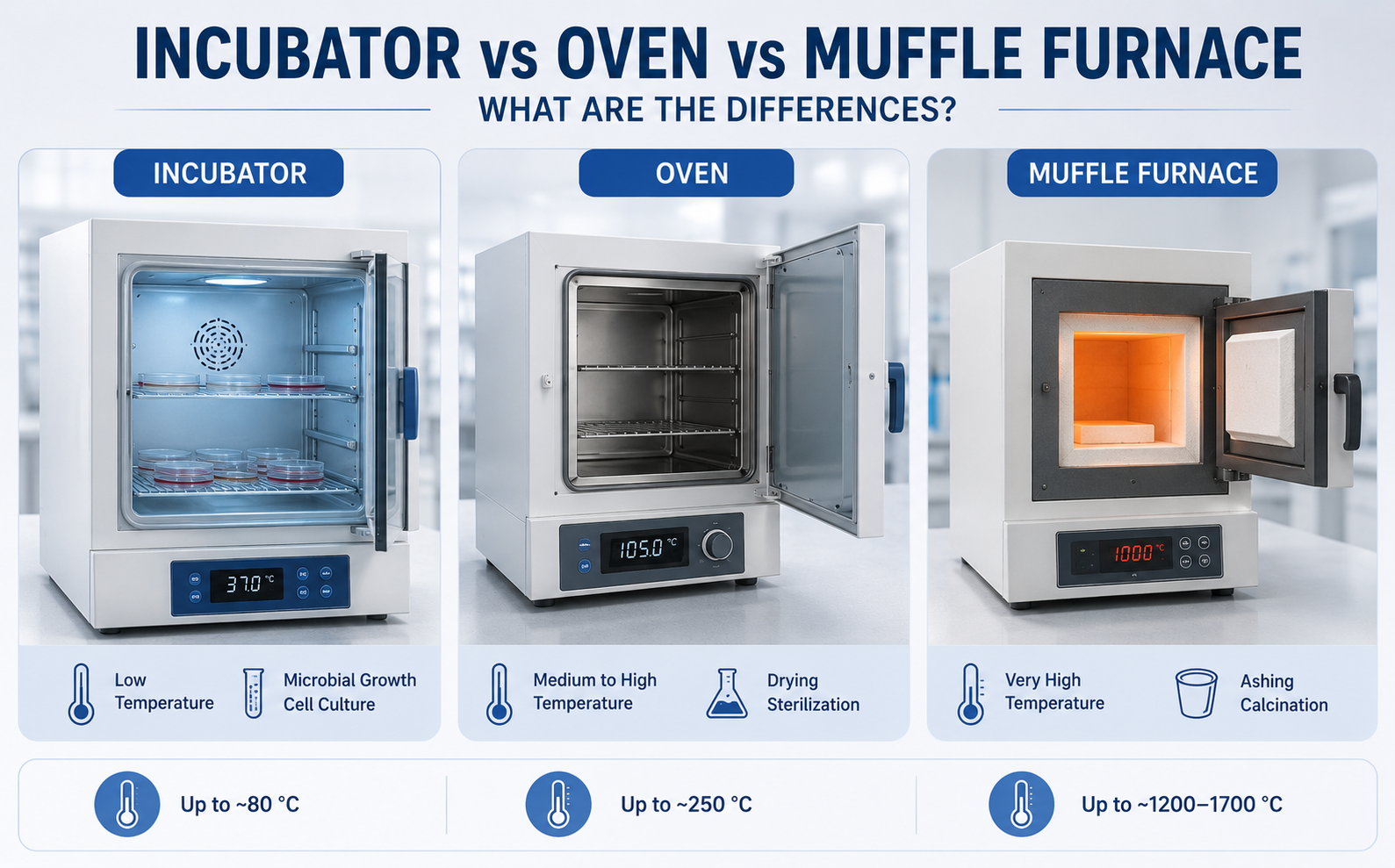
A laboratory oven is one of the most commonly used instruments for controlled drying, heating, moisture removal, sample preparation and thermal conditioning. Laboratory ovens are widely used in chemical, food, pharmaceutical, environmental, materials, quality-control and research laboratories. Choosing the correct oven, however, involves much more than checking its maximum temperature. Important parameters include temperature range, uniformity, stability, chamber volume, air circulation, heating method and sample characteristics.

What Is a Laboratory Oven?
A laboratory oven is a controlled-temperature chamber designed to heat or dry samples and laboratory materials.
Common applications include:
- sample drying,
- moisture removal,
- drying laboratory glassware,
- thermal treatment,
- controlled-temperature conditioning,
- gravimetric sample preparation,
- materials testing,
- quality control.
How Does a Laboratory Oven Work?
Electrical heating elements raise the temperature inside the chamber. A temperature sensor monitors the chamber while the control system regulates heating to maintain the selected setpoint.
Depending on the design, heated air may circulate through natural convection or forced convection.
This is one of the most important distinctions when selecting an oven.
What Is a Natural Convection Oven?
A natural convection oven relies on the natural movement of heated air.
Warm air rises while cooler air moves downward, creating passive circulation inside the chamber.
Potential advantages include:
- lower air movement,
- suitability for lightweight or sensitive samples,
- simple operating principle,
- no fan-generated airflow.
Natural convection can be useful when strong air movement might disturb powders or lightweight materials.
What Is a Forced Convection Oven?
A forced convection oven uses a fan to circulate heated air throughout the chamber.
Potential advantages include:
- faster heat distribution,
- generally faster temperature recovery,
- improved circulation around loads,
- potentially better temperature uniformity in many applications.
Actual performance still depends on oven design, temperature and loading conditions.
Natural vs. Forced Convection
| Feature | Natural Convection | Forced Convection |
|---|---|---|
| Air circulation | Natural | Fan-assisted |
| Air movement | Lower | Higher |
| Heat distribution | May be slower | Generally faster |
| Temperature uniformity | Model-dependent | Often better |
| Powders/light samples | May be advantageous | Airflow may disturb samples |
| Heating/recovery | Generally slower | Generally faster |
| Routine drying | Suitable | Excellent |
Forced convection is therefore not automatically better for every application.
Laboratory Oven vs. Incubator
They are not the same instrument.
A laboratory oven is primarily designed for drying and heating, usually at higher temperatures.
An incubator is designed mainly for controlled incubation of biological and microbiological samples, commonly at lower temperatures.
For example, bacterial incubation at 37 °C would normally require a suitable incubator, while drying appropriate laboratory glassware at 105 °C is a typical oven application.
Laboratory Oven vs. Muffle Furnace
The operating temperature and intended applications are significantly different.
Laboratory ovens generally operate up to several hundred degrees Celsius depending on the model.
A muffle furnace is designed for much higher temperatures and applications such as:
- ashing,
- ignition,
- high-temperature heat treatment,
- materials testing.
Processes requiring 500–1000 °C or higher generally require an appropriate furnace rather than a standard laboratory oven.
Where Are Laboratory Ovens Used?
Chemical Laboratories
For sample drying, glassware drying, preparation for constant-mass measurements and selected thermal treatments.
Food Laboratories
For moisture or dry-matter determination according to applicable analytical methods.
Pharmaceutical Laboratories
For sample preparation, drying, quality-control procedures and method-defined thermal processes.
Environmental Laboratories
For preparing soil, sediment and other environmental samples.
Materials Laboratories
For conditioning, aging and drying polymers, coatings, metals and other materials.
Educational Laboratories
For routine drying and general laboratory applications.
Moisture Determination
Some gravimetric moisture methods involve drying a sample at a specified temperature and comparing its mass before and after drying.
A simplified workflow may be:
Initial weighing → Drying → Cooling in a desiccator → Reweighing
However, the required temperature, time and calculation depend on the sample and analytical method.
Applicable standards, pharmacopoeias, official methods or validated laboratory procedures should therefore be followed.
Why Is Temperature Range Important?
The operating temperature range is one of the first specifications to consider.
If routine applications are performed at:
- 40 °C,
- 60 °C,
- 105 °C,
- 150 °C,
- 200 °C,
the oven should provide suitable performance at those actual working temperatures.
Maximum temperature alone is not sufficient.
Is Maximum Temperature the Most Important Specification?
No.
Two ovens may both have a maximum temperature of 300 °C while providing very different:
- temperature uniformity,
- temperature stability,
- heat-up times,
- recovery times,
- control performance.
The highest temperature printed in a specification sheet therefore provides only part of the information required.
What Is Temperature Uniformity?
Temperature uniformity describes how similar temperatures are at different locations within the chamber.
If the oven is set to 105 °C, temperatures near the top, bottom, front, rear and center should ideally remain within the required range.
Uniformity becomes particularly important when multiple samples are processed simultaneously.
What Is Temperature Stability?
Temperature stability describes how consistently the temperature at a given point remains around the set value over time.
These terms should not be confused:
Uniformity → Temperature differences between locations
Stability → Temperature variation over time at a location
Both should be considered when selecting an oven.
Does Display Resolution Equal Temperature Accuracy?
No.
An oven displaying:
105.0 °C
does not necessarily mean that every location in the chamber is exactly 105.0 °C.
Display resolution, sensor performance, temperature uniformity and stability are different characteristics.
How Should Chamber Volume Be Selected?
Laboratory ovens are available in many capacities, for example:
- 30 L,
- 50 L,
- 100 L,
- 150 L,
- 250 L,
and larger.
Selection should also consider:
- number of samples,
- dimensions of sample vessels,
- shelf configuration,
- daily workload,
- required clearance for airflow.
Overloading an oven can restrict air circulation and negatively affect temperature distribution.
Why Is Shelf Arrangement Important?
Samples should generally be positioned so that they do not:
- block air inlets or outlets,
- sit excessively close together,
- unnecessarily contact chamber walls,
- interfere with the designed airflow.
This is particularly important in forced-convection ovens.
What Is Heat-Up Time?
Heat-up time is the time required for the oven to reach its target temperature from its starting condition.
A shorter heat-up time may improve workflow in frequently used laboratories.
However, heat-up speed should be evaluated together with uniformity and stability.
What Happens When the Door Is Opened?
Opening the door allows hot air to escape and chamber temperature to fall.
After closing the door, the oven requires time to return to operating conditions.
This is associated with recovery time.
Recovery performance can be important in laboratories where samples are frequently loaded and removed.
Why Does Chamber Material Matter?
Many laboratory ovens use stainless-steel interiors because they can provide:
- durability,
- easy cleaning,
- corrosion resistance.
For applications that may release aggressive chemical vapours, however, compatibility with chamber materials must be verified with the manufacturer.
Can Solvents Be Dried in a Standard Laboratory Oven?
This requires particular caution.
Standard laboratory ovens are not automatically designed to safely handle flammable or explosive solvent vapours.
Samples releasing vapours from substances such as:
- ethanol,
- methanol,
- acetone,
- hexane,
- other flammable solvents
may create serious fire or explosion hazards in unsuitable equipment.
Special equipment specifically designed and approved for the intended application may be required.
Never assume that a standard laboratory oven is solvent-safe.
Always evaluate the SDS, risk assessment and manufacturer's instructions.
Can Laboratory Glassware Be Dried in an Oven?
Appropriate laboratory glassware can often be oven-dried, but consider:
- glass temperature resistance,
- plastic components,
- caps and seals,
- calibration or volumetric properties.
For volumetric glassware in particular, manufacturer recommendations should be followed because excessive heating may affect metrological characteristics.
Can Plastic Labware Be Oven-Dried?
Extra care is required.
PP, PE, PTFE, PS and other polymers have different temperature limitations.
Excessive heat can cause:
- deformation,
- softening,
- dimensional changes,
- material degradation.
The manufacturer's maximum recommended temperature should therefore be checked before placing plastic labware in an oven.
Why Is Over-Temperature Protection Important?
Over-temperature protection is an important safety feature.
If the primary temperature-control system fails, an additional or independent safety system can help prevent the chamber from exceeding a defined safety limit.
This is particularly useful for:
- long-duration processes,
- unattended operation,
- temperature-sensitive samples.
Do You Need a Timer or Programmable Controller?
It depends on the application.
Simple drying procedures may only require basic temperature and time settings.
More advanced ovens may offer:
- delayed start,
- timers,
- temperature ramps,
- multi-step programs,
- data logging.
Programmable control can be useful for processes requiring controlled heating profiles.
Why Is Data Logging Important?
In quality-controlled laboratories, it may be necessary not only to set temperature but also to document it.
Advanced ovens may provide:
- USB,
- Ethernet,
- computer connectivity,
- internal data logging.
Regulated laboratories should additionally consider their applicable data-integrity and record-keeping requirements.
Why Is Oven Calibration Important?
A display reading of 105 °C does not guarantee that every point inside the chamber is exactly 105 °C.
Critical applications may therefore require temperature performance to be evaluated against suitable reference standards.
Calibration or performance checks may assess:
- temperature sensors,
- displayed values,
- different chamber locations,
- relevant operating temperatures.
The required scope depends on the laboratory's quality system and application.
Temperature Mapping
For pharmaceutical, quality-control and other standardized applications, temperature mapping may be required.
Multiple temperature sensors are positioned throughout the chamber to evaluate:
- hot and cold locations,
- uniformity,
- stability,
- loading effects.
This provides a more complete understanding of the oven's actual operating performance.
12 Criteria for Choosing a Laboratory Oven
Consider:
- Operating temperature range
- Temperature uniformity
- Temperature stability
- Chamber volume
- Natural or forced convection
- Heat-up time
- Recovery performance
- Interior and shelf materials
- Over-temperature protection
- Timer and programming functions
- Calibration and data-logging options
- Sample and process safety
Quick Selection Guide
| Requirement | Key Consideration |
|---|---|
| General sample drying | Standard laboratory oven |
| Many samples | Adequate chamber volume and airflow |
| Improved heat distribution | Forced convection may help |
| Lightweight/powder samples | Consider natural convection |
| Temperature-critical process | Uniformity + stability |
| Gravimetric analysis | Method-compliant temperature performance |
| Programmed thermal treatment | Programmable controller |
| Quality-system laboratory | Calibration + data logging |
| Flammable-solvent samples | Do not assume a standard oven is suitable |
| High-temperature ashing | Appropriate muffle furnace |
Common Selection Mistakes
Common mistakes include choosing an oven based only on maximum temperature, ignoring temperature uniformity, selecting insufficient chamber volume, overloading the chamber, blocking airflow, confusing display resolution with accuracy, overlooking calibration requirements, drying flammable solvents in unsuitable equipment and confusing ovens with incubators or high-temperature furnaces.
Conclusion
A laboratory oven is an essential instrument for controlled drying, heating, moisture removal and sample preparation.
Selecting the correct instrument requires more than simply comparing maximum temperatures.
The most important criteria can be summarized as:
Temperature Range → Uniformity → Stability → Volume → Air Circulation → Safety → Calibration
A standard oven may be sufficient for routine drying, while quality-control and standardized analytical procedures may require much tighter temperature performance, calibration and documentation capabilities.
Sample characteristics must also be considered carefully. In particular, samples capable of releasing flammable solvent vapours should not be processed in a standard laboratory oven unless the equipment is specifically designed and approved for that application.
A properly selected and correctly operated laboratory oven provides the foundation for reliable and repeatable thermal processing in the laboratory.