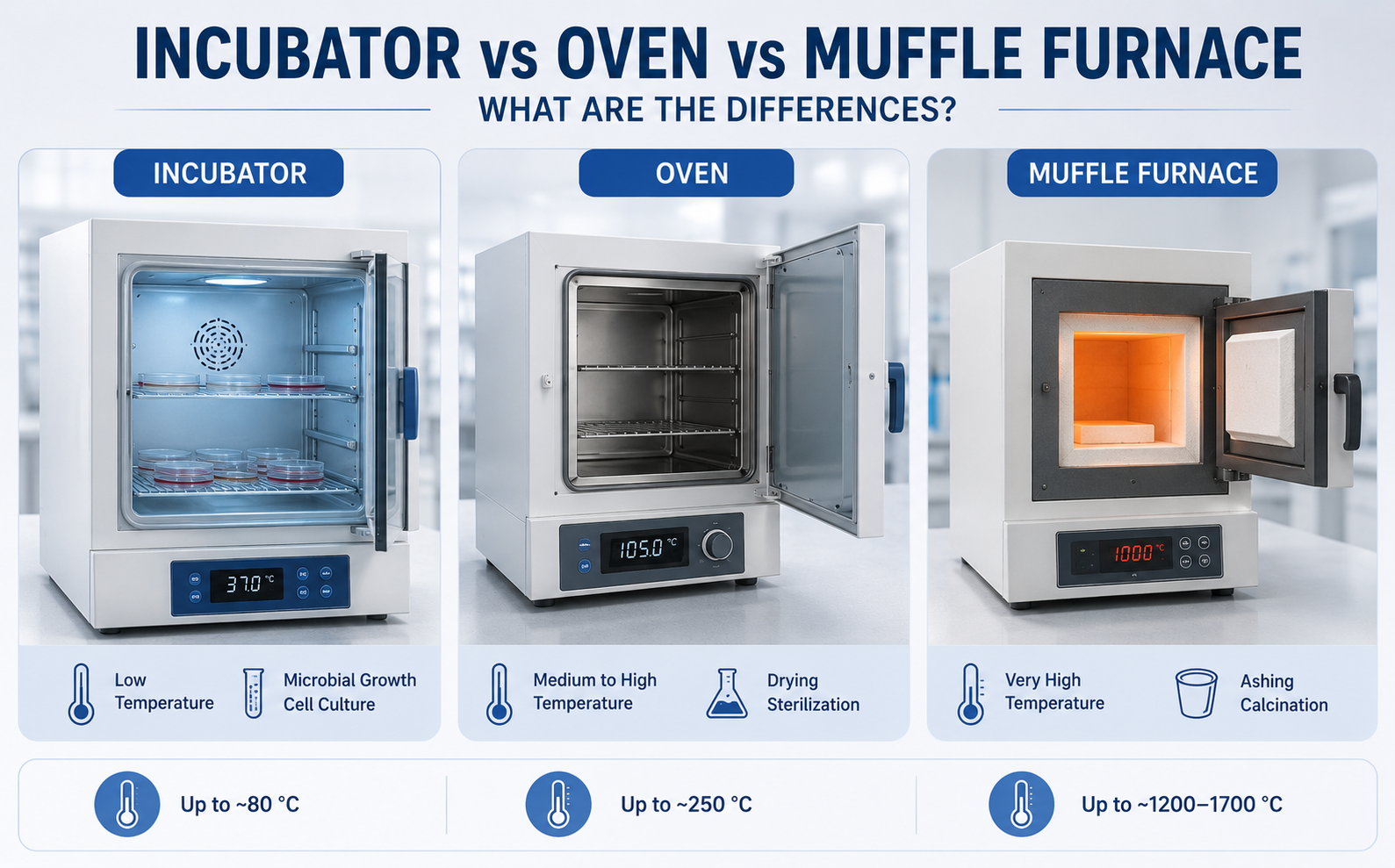
Laboratories perform many processes that require carefully controlled temperatures. One of the most important instruments for maintaining biological and microbiological samples under controlled conditions is the laboratory incubator. Although incubators may look similar to laboratory ovens, their purpose, operating temperature, temperature-control characteristics and applications are different. In simple terms: Incubator → Controlled incubation of biological and microbiological samples Laboratory Oven → Drying, heating and moisture removal

Laboratories perform many processes that require carefully controlled temperatures. One of the most important instruments for maintaining biological and microbiological samples under controlled conditions is the laboratory incubator.
Although incubators may look similar to laboratory ovens, their purpose, operating temperature, temperature-control characteristics and applications are different.
In simple terms:
Incubator → Controlled incubation of biological and microbiological samples
Laboratory Oven → Drying, heating and moisture removal
What Is a Laboratory Incubator?
A laboratory incubator is a temperature-controlled chamber designed to maintain samples at specified conditions for a defined period.
It is widely used in:
- microbiology,
- molecular biology,
- biotechnology,
- food microbiology,
- clinical laboratories,
- pharmaceutical quality control,
- environmental laboratories,
- research laboratories.
The main purpose of an incubator is not to generate very high temperatures but to maintain the required incubation temperature accurately and consistently.
How Does an Incubator Work?
A heating system brings the chamber to the selected temperature.
A temperature sensor continuously monitors the chamber, while the controller regulates heating to maintain the setpoint.
Depending on the design, air circulation may be:
- natural convection,
- forced convection.
Specialized incubators may additionally control parameters such as CO₂, humidity, oxygen or light.
What Is an Incubator Used For?
Typical applications include:
- bacterial culture incubation,
- yeast and selected fungal cultures,
- microbiological analysis,
- food microbiology testing,
- microbiological water analysis,
- pharmaceutical microbiology,
- controlled storage of biological samples,
- selected stability and quality-control tests.
The required temperature and incubation period should always be determined by the relevant organism, analytical method or standard.
What Is Incubation?
Incubation means maintaining a sample under defined environmental conditions for a specified period.
In microbiology, it commonly refers to providing appropriate temperature conditions for microbial growth.
Some bacteria, for example, may be incubated around 35–37 °C. However, this is not a universal incubation temperature.
Different organisms and methods may require substantially different conditions.
Therefore, incubation temperature and time should follow the applicable ISO/EN standard, pharmacopoeia, official method or validated laboratory procedure.
Incubator vs. Laboratory Oven
An incubator and an oven may have similar chamber designs, but they are not interchangeable.
An incubator is optimized for maintaining controlled conditions, typically at low to moderate temperatures.
A laboratory oven is primarily designed for drying, moisture removal and heating, usually at higher temperatures.
| Feature | Incubator | Laboratory Oven |
|---|---|---|
| Main purpose | Incubation | Drying and heating |
| Typical temperature | Low/moderate | Moderate/high |
| Microbial cultures | Excellent | Generally unsuitable |
| Sample drying | Not primary purpose | Excellent |
| Moisture removal | Not primary purpose | Excellent |
| Glassware drying | Generally not preferred | Suitable |
| Bacterial incubation | Excellent | Generally unsuitable |
| Gravimetric drying | Generally unsuitable | Excellent |
| Temperature control | Focused on incubation | Focused on heating/drying |
| Maximum temperature | Usually lower | Usually higher |
Exact temperature ranges vary by instrument and should be verified from the manufacturer's specifications.
Why Is 37 °C Common?
Approximately 37 °C is close to human body temperature and is therefore commonly used for certain human-associated microorganisms and biological systems.
However:
Not every microorganism should be incubated at 37 °C.
Some methods require temperatures around 20–25 °C, 30 °C or other conditions.
The analytical method should always determine the incubation temperature.
Why Do Laboratory Ovens Operate at Higher Temperatures?
Laboratory ovens are often used to remove moisture or provide controlled heating.
Temperatures such as:
- 60 °C,
- 105 °C,
- 150 °C,
- 200 °C
may therefore be encountered in different oven applications.
For example, some gravimetric moisture methods use temperatures around 105 °C.
The actual temperature must always follow the relevant analytical procedure.
Temperature Uniformity
Temperature uniformity describes how similar the temperature is at different locations within the chamber.
When an incubator is set to 37 °C, samples placed on different shelves should experience temperatures within the required tolerance.
Uniformity is particularly important when many samples are incubated simultaneously.
Temperature Stability
Temperature stability describes how consistently the temperature remains around the setpoint over time.
The distinction is:
Uniformity → Differences between different chamber locations
Stability → Temperature variation over time
Both are important characteristics of a laboratory incubator.
Natural Convection Incubators
Natural convection systems rely on the natural movement of heated air.
Potential advantages include:
- low air movement,
- simple construction,
- gentle conditions for sensitive samples,
- no fan-generated airflow.
Forced Convection Incubators
A forced convection incubator uses a fan to circulate air throughout the chamber.
This can help provide:
- faster heat distribution,
- improved temperature uniformity,
- faster recovery after door opening.
Actual performance depends on instrument design and loading conditions.
What Is a Refrigerated Incubator?
A refrigerated or cooled incubator provides both heating and cooling.
It is useful when the required incubation temperature may be close to or below ambient temperature.
Applications can include:
- environmental analysis,
- food testing,
- microbiology,
- stability testing,
- low-temperature incubation.
What Is a CO₂ Incubator?
A CO₂ incubator is a specialized instrument primarily used for cell and tissue culture.
In addition to temperature, it controls a defined CO₂ concentration and, in many systems, suitable humidity conditions.
Applications include:
- cell culture,
- tissue culture,
- biomedical research,
- biotechnology,
- pharmaceutical R&D.
A standard microbiological incubator should not be confused with a CO₂ incubator.
What Is a BOD Incubator?
A BOD incubator is commonly used in environmental and water-analysis laboratories.
BOD stands for Biochemical Oxygen Demand.
BOD testing can require samples to remain at specified conditions for extended periods, making temperature stability and long-term operation particularly important.
Incubators in Microbiology Laboratories
Microbiology is one of the most common applications for laboratory incubators.
Samples prepared in Petri dishes, tubes or other suitable culture vessels are placed in the incubator at the temperature specified by the method.
After the required incubation period, laboratories may evaluate:
- colony development,
- microbial growth,
- biochemical reactions.
Incubators in Food Laboratories
Food laboratories use incubators extensively for microbiological quality control.
Depending on the applicable method, incubation may be required for:
- total viable counts,
- yeast and mold testing,
- detection or enumeration of specific microorganisms.
The required time and temperature must follow the relevant standard.
Pharmaceutical Applications
Pharmaceutical laboratories may use incubators for:
- microbiological quality control,
- environmental monitoring samples,
- selected microbial limit tests,
- research and development.
Where pharmacopoeial or quality-system requirements apply, equipment performance, calibration and documentation become especially important.
How to Choose a Laboratory Incubator
Consider:
- Temperature range
- Temperature uniformity
- Temperature stability
- Chamber volume
- Natural or forced convection
- Cooling requirements
- Shelf capacity and configuration
- Door design
- Over-temperature protection
- Timer and programming functions
- Calibration capability
- Data logging
- Ease of cleaning and disinfection
- Application-specific requirements
Chamber Capacity
Do not select an incubator based only on its nominal volume.
Also consider:
- daily sample load,
- number of Petri dishes or tubes,
- shelf capacity,
- sample dimensions,
- required airflow clearance.
Overloading the chamber can restrict air circulation and negatively affect temperature uniformity.
Why Do Some Incubators Have an Inner Glass Door?
Some incubators have a second glass door behind the main outer door.
This allows samples to be observed while reducing direct exposure of the chamber to ambient air.
Potential benefits include:
- reduced temperature loss,
- easier observation,
- improved temperature recovery.
Cleaning and Contamination Control
Because incubators are frequently used with biological and microbiological samples, cleanliness is critical.
Contamination inside the chamber can affect:
- samples,
- cultures,
- analytical results.
A smooth, durable and easily cleaned interior is therefore advantageous. Stainless-steel chambers are commonly used.
Calibration and Temperature Mapping
A display reading of 37.0 °C does not necessarily mean that every location in the chamber is exactly 37.0 °C.
Critical applications may require calibration and temperature mapping.
Temperature mapping uses multiple sensors positioned throughout the chamber to evaluate:
- hot and cold locations,
- temperature uniformity,
- stability,
- effects of loading.
This can be particularly important in laboratories operating under formal quality systems.
Which Should You Choose?
Choose an Incubator When:
- Culturing bacteria
- Performing microbiological analyses
- Maintaining samples at controlled temperatures for extended periods
- Working with biological samples
- Performing low- or moderate-temperature incubation
Choose a Laboratory Oven When:
- Drying samples
- Removing moisture
- Performing gravimetric drying
- Drying suitable laboratory materials
- Performing controlled heating at higher temperatures
Quick Selection Guide
| Application | Recommended Instrument |
|---|---|
| Bacterial incubation | Incubator |
| Yeast/mold studies | Suitable incubator |
| Cell culture | CO₂ incubator |
| BOD analysis | Suitable refrigerated/BOD incubator |
| Microbiological QC | Incubator |
| Sample drying | Laboratory oven |
| Glassware drying | Laboratory oven |
| Gravimetric moisture determination | Laboratory oven |
| Drying at 105 °C | Laboratory oven |
| Controlled low-temperature incubation | Suitable incubator |
| High-temperature heat treatment | Oven or suitable furnace |
| Ash determination | Muffle furnace |
Common Mistakes
Common mistakes include treating incubators and ovens as interchangeable, selecting equipment only by maximum temperature, ignoring temperature uniformity, overloading the chamber, blocking airflow, opening the door unnecessarily, neglecting calibration, selecting incubation temperatures without consulting the method and overlooking contamination control.
Conclusion: Incubator or Laboratory Oven?
Both instruments provide controlled-temperature environments, but their purposes are fundamentally different.
The distinction can be summarized as:
Incubator → Controlled incubation and biological/microbiological applications
Laboratory Oven → Drying, moisture removal and controlled heating
When choosing an incubator, focus on temperature range, uniformity, stability, chamber capacity and the requirements of the biological application.
When choosing a laboratory oven, drying temperature, airflow, chamber capacity, thermal performance and safety become more important.
The correct choice should therefore be based not on appearance or maximum temperature, but on the actual requirements of the laboratory process.