Laboratory glassware, metal components and reusable equipment can accumulate chemical residues, oils, particles and other contaminants. Cleaning narrow spaces or complex components manually can be particularly difficult. Ultrasonic cleaners use high-frequency sound waves in a cleaning liquid to provide effective cleaning, including areas that are difficult to reach manually.
What Is an Ultrasonic Cleaner?
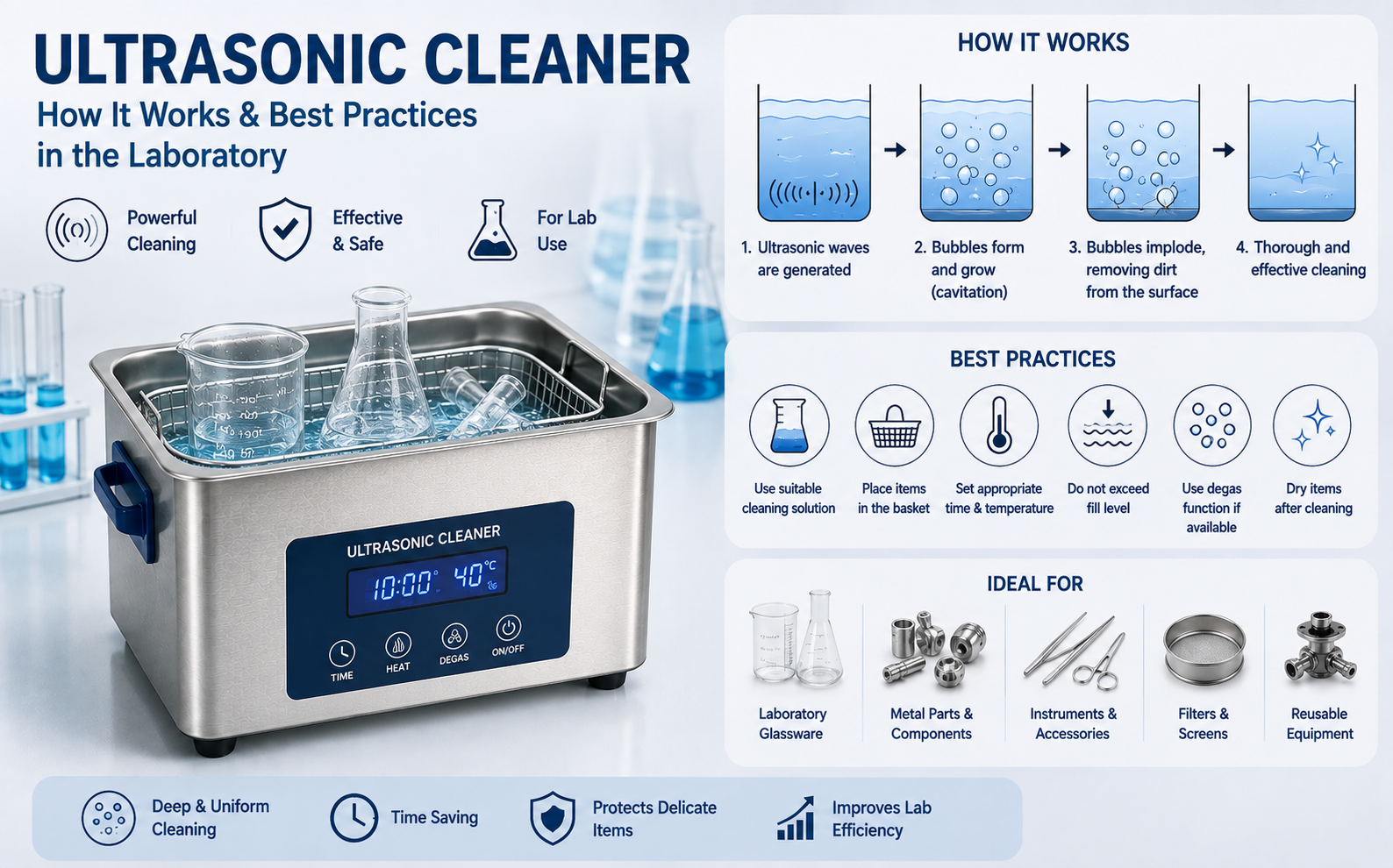
An ultrasonic cleaner consists of a tank containing a cleaning liquid and transducers that generate high-frequency mechanical vibrations.
These vibrations produce microscopic bubbles within the liquid. The bubbles repeatedly form and collapse in a process known as cavitation.
How Does Cavitation Clean?
When microscopic bubbles collapse, they generate localized mechanical effects and micro-streaming.
These effects help loosen:
- oils,
- particles,
- dust,
- certain chemical residues,
- surface contamination.
Because the liquid can penetrate small spaces and complex geometries, ultrasonic cleaning can reach areas that brushes or manual cleaning methods may not easily access.
Where Are Ultrasonic Cleaners Used in Laboratories?
Depending on material compatibility and the cleaning procedure, ultrasonic cleaners can be used for:
- laboratory glassware,
- metal components,
- stainless-steel equipment,
- small mechanical parts,
- laboratory accessories,
- filter and sieve components,
- reusable equipment.
Not every product is suitable for ultrasonic cleaning. Delicate coatings, certain plastics, electronic components and fragile items should be evaluated carefully.
How Is Ultrasonic Cleaning Performed?
1. Select the Correct Cleaning Solution
The solution must be compatible with both the contamination and the material being cleaned.
Suitable water-based cleaning solutions are commonly used for general laboratory applications.
Flammable solvents should not be used directly in a standard ultrasonic bath unless the equipment and procedure are specifically designed and approved for that purpose.
2. Fill the Tank Correctly
Maintain the liquid between the manufacturer's specified minimum and maximum levels.
Operating with insufficient liquid may reduce performance and potentially damage certain systems.
3. Degas the Solution
Fresh cleaning solutions may contain dissolved gases that reduce cavitation efficiency.
Some ultrasonic cleaners therefore include a Degas function to remove dissolved gases before cleaning.
4. Use a Cleaning Basket
Items should generally not be placed directly on the bottom of the ultrasonic tank.
A suitable basket helps position the components correctly and protects the tank and transducer system.
5. Set the Appropriate Time and Temperature
Cleaning performance depends on:
- ultrasonic frequency,
- temperature,
- cleaning time,
- cleaning solution,
- type of contamination.
Longer cleaning times and higher temperatures do not always produce better results. Excessive treatment may damage sensitive materials.
What Is the Advantage of a Heated Ultrasonic Cleaner?
Many ultrasonic cleaners include integrated heating.
An appropriate temperature can improve the effectiveness of certain cleaning solutions and help remove oils and other contaminants.
However, the temperature must be compatible with both the cleaning solution and the item being cleaned.
Why Is Ultrasonic Frequency Important?
Frequencies around 40 kHz are common in general-purpose laboratory ultrasonic cleaners.
In general, lower frequencies can produce more aggressive cavitation, while higher frequencies may be useful for more delicate cleaning.
However, cleaning performance also depends on transducer design, power distribution and tank geometry.
Can Laboratory Glassware Be Ultrasonically Cleaned?
Many laboratory glassware products in good condition can be cleaned ultrasonically.
However, glassware should be inspected first.
Cracked, chipped, heavily scratched or mechanically damaged glassware should not be placed in an ultrasonic bath.
Items should also be positioned to prevent them from striking each other during cleaning.
Does Ultrasonic Cleaning Sterilize Equipment?
No. Cleaning and sterilization are different processes.
Ultrasonic cleaning helps remove contamination and residues from surfaces, but it should not automatically be considered a sterilization method.
If sterile equipment is required, an appropriate validated sterilization process should be used separately.
Common Ultrasonic Cleaning Mistakes
Common mistakes include:
- Placing items directly on the tank bottom.
- Using an incompatible cleaning solution.
- Using flammable solvents in a standard ultrasonic cleaner.
- Operating with insufficient liquid.
- Cleaning delicate parts for too long.
- Using unnecessarily high temperatures.
- Cleaning damaged glassware.
- Assuming ultrasonic cleaning provides sterilization.
What Should You Consider When Choosing an Ultrasonic Cleaner?
Important selection criteria include:
- tank capacity,
- ultrasonic frequency,
- ultrasonic power,
- temperature control,
- timer,
- Degas function,
- basket and accessories,
- tank material,
- safety features.
When selecting tank capacity, consider not only the nominal volume but also the dimensions of the items and usable basket space.
Conclusion
Ultrasonic cleaners provide an effective method for cleaning laboratory equipment, particularly surfaces and areas that are difficult to reach manually.
Their fundamental operating principle, cavitation, uses microscopic bubbles in the cleaning liquid to help remove contaminants from surfaces.
For reliable cleaning, the correct solution, appropriate temperature and time, proper basket use and material compatibility should all be considered.
When used correctly, ultrasonic cleaning can provide laboratories with a more effective, controlled and repeatable cleaning process.